Wednesday, December 31, 2014

Our Summer Vacation - The Adoration

     We went back to the US for Christmas to see St. Matthew, our 2 ½ month old grandson. A 1 ½ mile walk from our homestead to the main road, 1 hour khumbi to Manzini, 5 hour international khumbi to OR Tambo airport, 9 hour flight to Munich, 9 to Dulles, and there He was, with his mother (our daughter). She had rented a house in Annapolis, Maryland, and her husband, our son and his wife, and my sister joined us. Christmas was a low key affair; good food and good times with family.
Holding that little boy, feeling his little body, seeing him look around and then smile when we drew near. Oh it was so very, very good, and so precious. And good to be with our family. But over in a flash!


     The long trip back was very smooth, but so sad. And then as soon as we arrived we hit phone and computer problems. We seem now to be slowly, arduously getting past them, but it certainly is trying our resolve. And how we miss that darling little boy and his mother. He had changed so much by the time we arrived from the pictures she had sent us, and then even in the 5 days we were with him, we hate to miss the intervening time with him. Our bodies hardly know what time zone they are in. It was nice to be heartily greeted back by our Swaiz family.
      We go Friday to a nearby game park with the excellent student from the refugee camp for whom we have become mentors; he got into the only public high school in the country offering the more advanced “A level” or “matric” courses; we will pay his tuition to that. We hope to spring him from the no-opportunity limbo in which refugees here are trapped.

      Then next week we go to Cape Town for a week, and back to Johannesburg to see the world-renowned Apartheid Museum. Then school starts. Onward.

Tuesday, December 9, 2014

2 different weddings

     Last Friday night, the night Katherine returned from working on Books For Africa applications at PC HQ, people started showing up at the homestead after dark. Our suspicion that a funeral was in the offing seemed to be confirmed when people stayed up all night, cooking and talking. They seemed merry, so we assumed the deceased was not close. Around 4 a.m., at the faintest hint of dawn, there was laughter and calling, then loud knocking and demands to wake up in the small hut just behind ours where the youngest brother in the family lives much of the time. When Katherine got up a little later (she really could have used a full night's sleep, but is pretty good now at getting by without) she learned that a traditional Swazi wedding, or really an engagement, was in progress in the kraal (the coral where the families cattle are kept) 200 meters away across the maize field .
Katherine dressed quickly and joined the ladies – men are not invited.
     We had heard a little about traditional “weddings” in training. On a night when the “bride” happens to be at the man's homestead, she is awakened early by the women of the homestead, who take her to the kraal, the symbol and center of the family's wealth, where she is told she is to marry the designated man. A song that I know well from the High School “traditional dancers” is sung, about her leaving her own family now and married life being difficult and painful and leading then to death; traditionally the intended would wail and cry. These days we are are told the bride generally has a sense of what is coming up, although she might not know the exact day; this bride knew the very day. Interestingly, the traditional wedding is not terribly common now, and the family of the “groom” said they had never been to a traditional wedding before; the neighbors, who are much more imbued with the tradition, did most of it. A sister of the groom explained that the Swazi Constitution forbids compelling the bride. ( I'm interested how frequently Swazis refer to protections in their Constitution; many of them know it well, but are also aware of some deviations in practice.) No friends or family of the bride were present; this was an event of the neighbors, assisting the groom's family.
       The groom told me that he would also do a “civil” wedding “signing the paper” before a government official, and he said that would have to be done by June. He also needs to negotiate the “lobola” (cows paid to the brides family, essentially dowry). The bride is a “double orphan” (both parents dead; single” and “double” orphan are useful concepts because children who have lost even one parent suffer similar diminution in health, education, and job prospects as with “double orphans.”), so the lobola is paid to the oldest brother; if you think of lobola as compensation for the cost of raising and educating the bride, I'm not sure older brothers are always entitled to much, but the concept is to compensate the bride's family for the transfer to the groom's family.
       The traditional wedding suggests roots in a less orderly past. It is easy to imagine a young woman being seized without her consent and taken to a man's homestead, then being introduced to the women of the homestead the next morning at the kraal, where she would see her new family's wealth, and the bride's family shortly being bought off, literally, with the promise of a payment of cows. The going price, paid even now, for healthy brides, is from 11 to 18 cows, but we understand there is a fixed lobola for a daughter of the king, of 115 cows. Since a young man's desires can often outrun his wallet, it is not unusual for lobola to be paid years, frequently decades, after the engagement, as the man saves up enough to provide the agreed number of cattle.
       This is a very Christian country, but the traditional wedding has nothing religious about it: no prayers, no hymns – that's all for the “white” wedding, which is in a church.
       I learned from the bride that her husband chose the traditional wedding because it costs less than a “white wedding” (in a church). But a traditional wedding allows polygamy. The bride told me she insisted that her husband promise no more wives unless she dies or they are divorced; polygamy would be illegal after a civil wedding. I hope that civil ceremony does occur, but even then, he has not appeared to have difficulty finding girl-friends. The husband has had 3 jobs since we've been here, none for more than a few months. His sisters agree he has a drinking problem. His lifestyle would make it very hard to have avoided HIV. This bride has a sense of her market value and, like a Jane Austin heroine, I guess she negotiated the best deal her circumstances permit; there was no one looking out for her. The 2 are very sweet together, and she is very good with his daughter.
       We like her a lot – she is smart, has pretty good English, is willing to try to be understood, and is fun.; I hope this works out well for her.
       The bride was a domestic worker here from around April to August, but left suddenly. She has 2 children; having one child makes a woman more marketable as a bride, because it shows she is fertile. Having more than one can be a negative.
        The “groom” was living, when we arrived here, with a smart, pretty, strong-minded woman who had a good job as a clerk at the nearby airport construction. Their 2-year-old was also here, but their relationship was already rocky when we arrived, and ended when she reported to the police that he had stolen some of her money, and a police car showed up on the homestead one night. Our Babe ( the father on the homestead, pronounced bäbā,) is a pastor, a member of the local “inner council” (kind of like country commissioners, but the position is either inherited or appointed), and an important member of the community; he must have been deeply embarrassed. The mother visited her 2 year old a few times after she left, but a child always belongs to the father's family, and we soon stopped seeing the mother. Likewise, the two children of today's bride live with her husband's mother who does not allow their mother to see them. The bride told me bringing them here would not work – they would always be blamed and criticized and treated badly.
      The groom had purchased a goat, which was slaughtered.


When you slaughter a goat, the first thing you do after cutting it's throat, letting the wriggling settle down, and hanging the carcass from a limb, is to cut off the penis, scrotum, and testicles, and set them on a limb.


I asked if there was any symbolism to that, because in some cultures those parts of some animals have significance, but it seems not here – it would just be in the way of cleanly slicing out the insides, I guess, and besides, who wants those parts still attached to their goatskin?
     While a meal was prepared the women built a fire on the road from the kraal and had tea.


After a while the women approached the homestead from the kraal.

They started throwing stones at us, because the men then had to go away, perhaps because the bride is still topless; she was very self-conscious about that, all day, until she was ceremonially dressed in married women's clothes: long dress, head scarf and scarf covering her shoulders. Fortunately the older brother on the homestead, with whom I was sitting, knew of traditional expectations, and he and I scurried off to our huts amid much laughter – those neighbor women had good aim! The women presented some symbolic gifts to the groom's family and jesting “negotiations” occurred, along the lines of “Where is the cow?” and “What color cow do you want?” Much laughter and good humor. But you could see the origins in a scared young girl being brought into a new homestead by the women, with the men excluded for that stage. The stories we hear suggest that often little care is taken for the young girl's sensibilities, as she is promptly put to work in all kinds of ways – the groom's family is going to have to pay for her, and want their money's worth!
       Katherine observed that this girl is going from paid domestic worker to unpaid daughter-in-law, but she has gained membership in a family, and my sense is the older generation in this homestead, especially the 2 oldest women, would try to treat her fairly.
        We had seen the final step in a traditional wedding when we first arrived at site and went with the family just across the border into South Africa to see the final lobola payment by the “groom” now in his 50s, the soonest he had accumulated enough to pay what he owed; the grandchildren of that marriage assisted at the wedding. That ceremony is intended to symbolize the joining of the families; the expectation and final accomplishment of that would be a useful step where such important property has been exchanged, perhaps initially somewhat abruptly. See (if you haven't already had quite enough of this) our September 12, 2013 blog..
     In the negotiations at the front door of the main house of the homestead the women of the household gave the new daughter-in-law advice, such as to be patient, and they then painted her forehead with ochre,

(Katherine took this picture – I was still excluded) had her suck the gall bladder of the goat (which tasted as you'd expect, I understood from her later), and symbolically tied around her right wrist the skin from the goat's forehead as a symbolic ring, which was only to be removed when she returned to her own home, which she would do the next day. I sat next to her when we ate, and could smell her “ring”; she was embarrassed by that and said she'd cover it that night, because of the smell.

That's the “ring” on her right wrist.
        After a while we assembled in a small room near the cooking shed and enjoyed the feast, as shown above. It was just the neighbor ladies, Katherine and me (I'm not sure men were to be included then, but they invited me; some rules apply less strictly to outsiders, I suspect. None of the groom's family joined them) I declined an offering from the pot where the goat insides had been cooked. One piece of the “flesh” was pretty good, I think from the back somewhere; I passed off the other piece to the neighbor girl (one of our students) sitting beside me – the piece had too much identifiable skin on it; ignoring my subterfuge I was complimented for cleaning my plate. Katherine was sure everyone wanted to see pictures of our grandson Matthew.


       As it happened, a “white wedding” was also staging from our homestead the same morning, because our Babe was performing this wedding for one of his parishioners at the church at the nearby School for the Deaf. The bride, bridesmaids, and flower girls bathed, dressed, and fidgetted at our homestead . That is our Babe with them, in the dark suit.

And they then drove off in fancy clean decorated cars.


          One lesson this experience keeps teaching me is the futility of prediction. Preparation is important, but then the unexpected invariably intervenes.
Wednesday, December 3, 2014

Exam period and the holidays

      After a really busy, sometimes frantic, October, our schedule dropped off a cliff to practically nothing in November. In October we were teaching 7 classes a week, 240 students, and we also had 1 or 2 tutoring sessions most days. But exams started early in November, so no classes met, and once classes finished the students were still required to come to school (although many didn't, presumably because the free lunch was not worth the transport cost and effort) while the teachers marked their papers. This sounded to us like the perfect opportunity for some large and small group activities, so we studied some programs recommended by the Peace Corps and also selected the two books in the High School library with multiple copies for 2 “book clubs” we wanted to start.
      But we had far less success than we expected. We had bad luck – rain and a competing NGO demonstration on male circumcision (important here) just as we tried to get started, but mostly it was hard to get the students interested in much that looked like work. We gave up on the large group, and had some successes with the book clubs. In each, at least one student read way ahead and finished within days. And sometimes the discussions were very thoughtful and deep. But we always had to go round up the students, and we found fewer and fewer. And this is the last week they will be in school, so we have little planned except our own travels and projects and planning for next term, until school starts January 20, 2015.

      The Rural Health Motivators are one of the most successful health measures in this country. 6 women selected by the community are well-trained and then continually circulate among about 20 – 40 homesteads assigned to each of them advising on health, hygiene, nutrition and related matters. They were Katherine's introduction to the community; they love her. 3 of them asked Katherine to teach them English. Actually, their English is already much better than our siSwati, and they do not need English either to improve their understanding of their work nor to communicate with their neighboring homesteads. I think it's just a matter of pride; maybe keeping up with the grandchildren. Each of the women arrived with a new notepad on which to take notes – no small expense for them. We taped a portable “white board” on the back of a door, shown here,
and when we came for the second session we replaced it with a homework poster of 20 words for parts of the body. I think they were delighted to have this vocabulary to study.
       Most of the volunteers in our group (now the veterans) and also the new group ( who are now through “Integration Period” and settling in, some more smoothly than others) assembled at the Country Director's house for Thanksgiving. It was so good to be with our friends for this family holiday, and the food was delicious.
Next year, in Denver. The US Ambassador gave us a ride to the bus rank; we talked about why Swaziland did so little to retain eligibility under the African Growth Opportunity Act; losing that tariff-free importation privilege is a self-inflicted disaster for this sad country. The Ambassador is a splendid diplomat and an atrocious driver, and in this country, there is much competition in the latter category.
    We stayed Thursday and Friday nights at a backpackers we like, splurging on 2 nights in a private room with its own shower and toilet – right there in the room! Ahhhh. No flies, spiders, cockroaches or snakes! Cost an extra US$4 per person per night - US$15 each.  Worth it, kakhulu (big time!) Thursday night Katherine worked with one of the other volunteers on the Books for Africa Committee preparing to review applications for libraries.
     Friday we climbed a fine local feature evocatively named Executioner's Rock.  The approach was really long, but we had great luck with rides.  Less so on the way back.  Long day.

     Katherine has now gone to PC HQ in Mbabane to review Books For Africa library applications, which were due December 1, and she's also been asked to help a new staff member organize the PC resource library. So I'm on my own here. Being very brave.

     The Country Director asked Katherine to speak with a USA Today reporter about being an older PC volunteer. Here's the link to the article: http://www.usatoday.com/story/news/nation/2014/11/26/peace-corps-older-50-volunteer-age/19278429/

Tuesday, November 25, 2014

Help Support New Libraries in Swaziland

“The library is a good place to spend time in. I say this because of the books that are intresting (sic). For the library to be opened is good for all of us. In reading the books it gives your mind some new words and other vocabulary sentences. There are books that you will read them for fun and some for knowledge. Do not be indifferent in reading books. Good luck, happy reading.” Form 1 student (equivalent of US grade 8)

The new library at our local high school has been a phenomenal success. The photos in this posting show Mcebo helping to register the new books

and students enjoying the new library.

Hundreds of books have been checked out since the library opened in June. One Form 1 student often checks out a new book each day. The teachers tell us they have seen a definite improvement in their students' exams and writing skills. Recently, a Form 3 girl was jumping up and down at the excitement of finding a book she wanted to read. We have several book clubs going affording us an opportunity to work directly with small groups of students. The High School received some books that were too young for those students, so we brought 3 boxes to the local primary school that lacks a library; whenever we bring a “box library” into classes at the primary school, the students eagerly swarm, delighted at the chance to read a book. At recess the students beg us to read to them.

This year Katherine (with Mark's help) is part of the Peace Corps' Books for Africa Swaziland Committee helping volunteers start 30 new libraries around the country. (We will not apply for a new library in our community this year.) The books are donated, but volunteers must raise half the shipping costs, this year $7617.

We are requesting readers of this blog to donate to Books For Africa to support our efforts and bring the joy of reading to the young people in Swaziland. We are convinced that improved English will help these students move from dependent poverty to becoming self-supporting citizens. The link to donate is:  https://donate.peacecorps.gov/index.cfm?shell=donate.contribute.projDetail&projdesc=15-645-001
Please make sure you include your name with the donation. The default for this site seems to be “anonymous”, and we were not able properly to thank many of you who donated last year.

We are well into our second and last year as Peace Corps volunteers. There have been many highs and some lows. Our work with libraries is one of our proudest efforts. Please help us continue this work.

We wish a happy Thanksgiving to all our friends and family who are following our blog.


Katherine and Mark

Monday, November 3, 2014

A Halloween Trick

     Technology is the toughest obstacle we've faced in the PC, starting from our first application and then endless medical review, and especially after we arrived: maintaining phone and internet access and keeping our computer operable. 2 weeks ago the 5th Horseman of the PC Apocalypse descended upon us when our computer froze into a loop we couldn't break. Many invocations of task manager and hard booting were to no avail, as were attempted interventions by the PC tech manager. We've now spent 3 full days and many worried hours visiting the best computer servicing location in SZ, who managed to fix the problem after several days of tests, and then literally days of downloading programs that did not survive the assault. We've now mostly returned to functionality – we think. I'm still getting used to the photo processing program I'm using now, and I'm not sure I'm compressing the pix as I should – you can let me know. The struggle continues. And we have no understanding of the cause of this early Halloween trick!

     We caught a Halloween celebration back on Saturday, Oct. 25, because that was when the new group could join us. Some of our group went all out on decorations. Boy can some of those new folks party – most of them till 3:30 or 4, a few all night; I know, cause I saw them still at it when I got up to pee, then went back to bed.

Then Katherine made a presentation the next Friday, Oct 31, to the new group about Books For Africa and had housing (and a hot shower!) at the training facility, so I joined some of our gang at a hostel to celebrate the real Halloween. I was glad to be at each, and I enjoy getting together with the gang, but it's not the same as when it was new and exciting a year ago. We're going to be ready to leave in 10 months.

     The school year is winding down. Grade 7s (in the primary schools) and Forms III and V (high school; roughly sophomores and seniors) have already started national exams, and all other grades and Forms start school tests next week, so this is the last week of classes. The students will still come to school, but there not be classes, so we won't have an opportunity to teach. So over the next month we will try to get some activities going on which we have been trained, that dramatize for them how infectious HIV can be and give practice on making good decisions. We'll see. It's called Grassroot Soccer, and is quite clever, using sports as a hook for the kids' interest; it gets at the behavior change which is the key to what we are trying to do. We will call it Grassroot Netball, because girls are our primary target; they are more vulnerable to HIV, and seem more willing to try to change.
In addition to our class teaching – 4 5th grade and 3 6th grade classes - we've been busy tutoring some Grade 7s and Form IIIs on their literature and English comprehension exams, and that has been a kick – some smart motivated kids, reading some very provocative literature on growing up, race, families, and sexual abuse. But that too is over now. The Form Vs will finish their exams this week and next – the girls are letting their hair grow so they can have extensions attached (prohibited at rural schools). And some of our favorites, who first introduced us to the school, will be gone.

      And here, by popular demand, is a picture of Matthew Hunter Coyle in his Halloween Pumpkin costume – he is sometimes known in this hemisphere as Litsanga Lomncane Kumnandze – the Sweet Little Pumpkin.


Martha records his gurgles and chuckles on WhatsApp and sends them to us. All who have heard them – fellow teachers, students, strangers on khumbis - have been charmed. Smart fella, that one, and very melodious!

Wednesday, October 22, 2014

“For unto us a [grand]son is born”

     We interrupt our usual programming for a special announcement: Last Wednesday, October 15, our daughter Martha gave birth to our first grandchild, Matthew Hunter Coyle, in Washington, D.C.
     She called us early the next day and told us his birth was more exciting than they had anticipated. The afternoon of the 15th she had contractions 4 minutes apart, so her husband Tyler drove her to the hospital, but they sent her home. ½ hour after getting home her water broke and contractions were coming every minute. They sped back, Tyler driving carefully, using the horn liberally, while trying to assist Martha who was lying in the back seat screaming as Matthew's birth became more imminent. At the hospital she could not sit in the wheelchair. Baby Matthew was born at 10 p.m., less than 10 minutes after their arrival. 7 lbs 6 oz. 20.5” She did it just on Motrin – no time for anything else!
     I was in the Swazi capital, Katherine back at site, at 2 p.m. our time Thursday when Martha tried to reach us. It took 3 calls to reach me, and the same for Katherine, because of thunder storms across the country. It was 8 a.m. for Martha; she sounded exhausted, hoarse, and so proud and happy, with her Little Bundle there beside her.
No phone call has ever made us so happy.
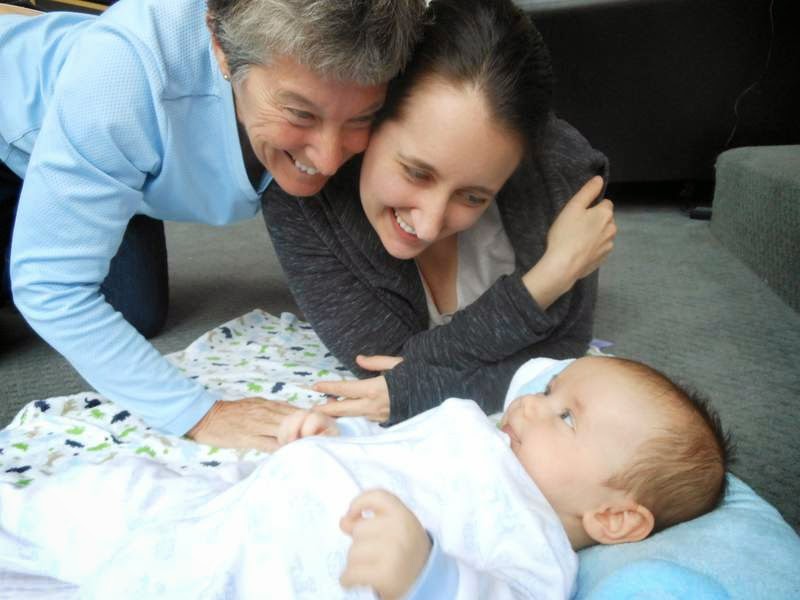
     Here is Matthew, 1 hour old:


And here he is 2 days later, at home, with a shirt we'd sent from Swaziland.


       When Martha told us in March that she was pregnant we were of course over-joyed. But both of us, without saying anything to each other, also felt personally, selfishly, very sad to miss the physical, tactile joy of our daughter's pregnancy and the first days of our grandson. We remember the morning after she called us with news of her pregnancy was one of our worst classes, with the large 19-year-old boys in the back of the 5th and 6th grades mocking us and disrupting, and we walked home wondering “Why are we here?” Others have stepped forward to celebrate for us: my sister gave a baby shower, and so did Tyler's mother and aunts. Our daughter Martha is a quick study and very cool customer, blessed with a clever, loving husband and a wise and helpful mother-in-law, so our presence in Maryland would be wholly superfluous. Except we hate to be missing this.
       When we left a year ago for our two year service we knew we would miss important events and turning points, and we have. Katherine and her father, age 94, knew it was very possible they would never see each other again, and spent 4 good days together in March, 2013, when he felt well; he died quickly last December. We missed family and friends' weddings and Katherine's Dad's interment; pictures, messages and calls from our family and children have filled us in. Katherine foresaw a possible pregnancy and knit pink and blue sweaters before we left; she pulled out some special blankets and clothes she had stored for 3 decades and gave them to my sister before we left, who passed them on. So intellectually Katherine was way ahead, but the reality still surprised us.

        We will go back to Maryland to have 5 days over Christmas with the 7 (!) of us – our son and his wife will come down from Boston. And my sister will join us – 8! Then, when we get back to Swaziland, there will be only 7 or so more months. Soon after we get back we've scheduled a trip to Cape Town and Stellenbosch before the new school term starts, anticipating a need to have something fun to look forward to. Fortunately, we are very busy here now, with classes and tutoring, some splendid kids whom we'd like to see launched successfully to the next step, and some more libraries to get established. And some good friends. We gather with many of the other volunteers at a backpackers this coming weekend to celebrate Halloween, and it's always fun to be with the gang. But when things don't go well – a bad night of sleep; a bug invasion; we step into a big fresh chicken poop in front of our door; a snake scares us; a class doesn't go well – we are quicker to get blue and start thinking “Do we have to keep doing this?” But so far, we are determined to stick it out here until our 27 months service is completed – there is still work we want to do here. We are, however, sure Matthew Coyle is going to need some serious grandparent attention when we get home.

Tuesday, September 30, 2014

Visitors from Denver!

     David and Maeve Franklin visited us this past weekend. They are friends through Katherine's 3-days-a-week “Walking Group,” which has been tremendously supportive of our effort here in lots of thoughtful ways. Both Maeve and David were born and schooled in South Africa, receiving medical training in Cape Town, but they left for the U.S. nearly 30 years ago. Their South African perspective was of particular interest. They are here for 2 family weddings in the province of South Africa that is just south of Swaziland, and for a visit to their summer home in the Eastern Cape.
They went with us to the two primary schools where we teach.
They spoke about medical careers, and then they met a ½ dozen of our favorite students we had assembled in the High School Library to talk about medical training and careers.

David and Maeve visited our local shebeen and sampled some home-brew, which they left behind, generating much cross-border good feeling.
We had lunch at our hut.
Notice the picture of Walking Group's Farewell Party 15 months ago behind us, beside Katherine's right ear.
     The Franklins brought some treasures to make our life here easier, carefully selected by Walking Group and my sister. These thoughtful deliveries from home make our life here easier and are very much appreciated.
     The Franklins then drove us 2 hours to the nicest game reserve in Swaziland, Mkhaya, where strenuous efforts have preserved “white” and “black” rhino and lots of other game.
     Mkhaya is very high end, and we were well fed and treated beautifully. We slept in thatched-roof huts with stone walls up to about a hard high, open to the bush above that, lit by kerosene lamps and lanterns. They brought us coffee and tea and biscuits at 5:30 a.m. before the 6 a.m. game drive.
     We talked with the Franklins about Denver news, changes in South Africa, retirement, religion, our work, other travels in the area, politics, birds . . . . David has a very quick eye and a long lens.
Bird Of The Day
     BotD honors had to go to fine multiple sitings of the purple-crested turaco, which David calls loerie, its Afrikaans name. A nice green with a bluish-purple head, it flashes a bright red under-wing when it flies; David was emphatic that the Swaziland national bird deserved BotD honors, and how could we assimilated Swazis disagree - the king wears 5 of its bright red feathers in his official traditional garb. It won out over stiff competition from the black-headed oriole with its gleaming yellow body, black head and red beak, and black and white edged wings, and also over the bearded woodpecker's black and white tummy stripes and red-crested head.

     Sunday we drove 1 ½ hours to Mabuda Farm; David is distantly related to the current owner! They had planned an outdoor braii, but had it inside because the weather was cold, windy and damp. The Mabuda Farm owners are at the far end of this picture, with Maeve and David and Katherine. Closer are 2 interns who had been training at the local hospital with Dr. Pons, an ophthalmologist there, and her parents who were visiting. This is the dining room in the enormous main house, which was built in the 1930s and has been in Helen Pons family since then.

     This was a really nice visit, with many flavors of home to enjoy while we visited with the Franklins and also in coming days.