Tuesday, July 29, 2014

An orphanage and Sheba's Breasts

     The 2nd term of school is winding down and we do not have much access to the students, with classes ending for exams, then a week when the students come to school, but no classes are held while the teachers mark the exams, and the final week when nothing much happens. So we occupy ourselves.
Friday we went to a new part of the country for us, Shiselweni, in the southeast, to visit a volunteer we like a lot. She lives at a beautiful farm where an orphanage for about 50 children was established maybe 10 years ago. She works very hard, but loves the kids, and they love her. It was nice to see a new part of the country, although traveling everywhere by public transport is exhausting, and going new places can be a challenge.       Here is the entrance to her orphanage.
Her hut

And the shop from which she sells necklaces and bracelets fabricated from wound paper by local women as an “income generating activity,” something we all seek to develop; the man is looking at samples for his shop. 
I'd loved to have photographed her with the children, but that is forbidden. It can be very lonely for these young people, and I think it was nice for her to have a visit. She calls us Papa Bear and Mama.
We stayed Friday night in the Ezulweni Valley, the most beautiful part of Swaziland, surrounded by rocky hills, where many of the wealthiest people in the country live. Saturday morning we hiked up a rocky ridge to 2 knobs evocatively named Sheba's Breasts. The trail was the nicest I've encountered in this country, starting through thick forests of beautiful old fig trees, then to open slopes with a final steep scramble.


The late winter flowering trees are coming into bloom
     We were tired and glad to get back to site Saturday afternoon. Near our site we heard some children singing at a nearby homestead. They were rehearsing a song to perform in church the next day: “Raise your hands to the Lord,” or something like that.
As we left the woman directing them said she did not have money to transport them to where they should perform. We said we were sorry.
     For the next 2 weeks we will try to get to the students when we can, reading stories or just visiting with them, going over the writing we try to have them do in “journals.” Katherine has pulled 2 boxes of books from the High School that are too young for the students there, from the Books for Africa grant the High School received in May. We are working with the Primary School principal to open a “box library” for the poorer primary school, where books are unavailable and craved by some.
     In 2 weeks we hope to go with the wealthier school's 5th and 6th grades to Durban, SA for 4 days on a bus trip. The trip is still uncertain, because they are still waiting to see if enough parents can pay the required US $260 for each student to go. We hope the trip goes; we really like many of these kids, and we've never been to Durban. Seeing it through their eyes would be fun. Two of the younger teachers are going.
     Then at the end of August we go off for 2 weeks seeing Victoria Falls, camping 3 nights in Chobe Park in Botswana, and then 2 nights at a remote camp in the Okavanga Delta. Then back to Swaziland for the start of the 3rd term. Towards the end of September Denver friends from South Africa visit and we go with them to one of the nicest game reserves in the country, one that is hard to reach by public transport.

     I rode my bike Sunday afternoon, for exercise. I heard one of a group of girls, all dressed up coming from church, call my name, so I stopped as I usually try to do when someone calls me by name, and walked a ways with them. She is in 10th grade at the High School. We talked about her up-coming exams. We passed a dressy middle-aged woman, who asked them questions in siSwati that I could not follow, prompting laughter. I asked what she had said. My student said she had asked which of them was my favorite. I said meaning girl-friend and she said yes. I hollered back at the woman, in my best siSwati, that I was a teacher, the girl was my student. But you know, the existence of that relationship does not dispel suspicion. Damn.

Tuesday, July 15, 2014

A knife attack at the dance competition

     Our school made the national finals in some of the dance categories. The finals were held in the nation's main commercial football stadium in Manzini, the commercial center. We hadn't been to the stadium, wanted to support the kids, and had no classes scheduled, so we went on the bus with them.
     Before leaving school the dancers fixed sandwiches for a late morning snack. Katherine is in the school kitchen with the lead dancer.
The heavy mid-day Swazi meal of rice, beans and roast chicken was brought to the stadium from the school later in the day, arriving around 3, so the sandwiches were to tide them over till then.
      The events our school performed in were the African Dance, which is not the traditional dance and is not the least bit African – performed to Western-style pop other PCVs dismissed as “from the 90s” (but they knew each tune – I didn't recognize a single one of them, which says more about how I spent the 90s than about the popularity of the music);
“drummies” - drum majorettes;
and “show prop” where they do “western-style” dance holding some kind of prop in their hands, again to Western recorded music. Some school teams had hula hoops, pompoms, ours had balloons. Unfortunately, several of our girls' balloons burst, causing lost points enough to eliminate us. Here they are getting ready to perform.
That's Manzini on the hill in the background.
     Our teams were done by noon, but Katherine and I lingered, to support the teams. We could have walked into town, done some productive shopping, and taken a commercial bus 45 minutes  back to our crossroads. As the winter afternoon waned it grew windy and colder; many of the kids were only wearing shirts, others had school uniform sweaters, hardly any had jackets. Katherine loaned her scarf and a blanket we'd brought to sit on to one of the boys we like a lot.
     Awards were announced starting around 4. Our school did not win any. Our kids were disappointed but not surprised, and glad to go home, but our bus had not arrived in the stadium parking lot. As we waited a half dozen young men, some visibly drunk, started pulling one of our girls away with them. The girl was smiling and laughing, and the other girls were cheering on all of them, in great good humor. We were told one of the men was saying the girl was his girlfriend, and they did seem to know each other. Fun or not, I hated the behavior.
     Dark fell, the parking lot emptied, the “super moon” rose - the full moon closest to the solstice I think that is, which is closest to the sun, I think, so it appears largest. (One of our Volunteer group sent around a message saying its called the “perigee moon.” Using an outdoor latrine, and ours is 60 yards away, gives you the opportunity to focus on to such events.) The bus was said to be coming in from the other side of the country, 60 miles away. It was cold.
     We heard the girls shriek and saw one of our favorite boys, the one to whom Katherine had loaned the scarf and blanket, lying on the pavement, nearly motionless, holding his shoulder. I thought I saw a pool of blood spreading from his back. Our boys grabbed the drummies' batons and groups of boys started running around the parking lot, clashing, chasing, fleeing, shouting. Our boys caught a boy who wasn't from our school. They brought him to where we were gathered and we could see him lying on the ground where they put him; I could not tell what they had done to him, or how they were holding him there. There were two “real” teachers, around 50 students, and us. It was confusing and frightening.
     Our injured friend was loaded into the back of a pickup and driven away. The police arrived, maybe 45 minutes after being called; I don't sense that the police in this country view protection of the citizens as their main purpose.
     The bus arrived, we got on and it left, but not by the direct route back to our town. In a few minutes the bus pulled over to the side of the road and out of the dark the injured student got on holding his shoulder, with the teacher in charge and the 2 friends who had gone with him in the truck. We were very glad to see him upright. We got back Katherine's scarf. When we got home and carefully inspected it for blood, we found 2 small puncture wounds in it.
     We pieced the story together from some girls, and from visiting our friend the next day at the High School,where he is a boarder. After the confrontation with the “girlfriend” some boys had been demanding of a small boy that the little one give them his money. Our friend intervened, the robbers surrounded him and one stabbed him from behind. Katherine's scarf absorbed some of the blow and probably kept the knife from penetrating as much as it might have otherwise.
     Saturday afternoon when we visited our friend, the day after the incident, he had still not told his family.

Swaziland is in the top 10 nations in the world in per capita murders. But I am reluctant to draw invidious comparisons from this one incident. We remember fights after games in the high schools we attended and our children attended. Younger kids are prey at some US schools, although I don't recall encountering knifings from behind. A police presence would have helped; there has been some pushing and shoving and visible drunkenness after each of the high school competitions we've attended. But the police here are busy elsewhere. The attacker was, however, arrested and our friend will go to the police station to “open a case.” We generally feel quite safe here, especially in our own community, where everyone knows us – we do kind of stand out.

Tuesday, July 8, 2014

Inverting the calendar: Christmas in June and July 4 in winter

     The group of volunteers who came a year before us is now starting to leave, so our group threw a party for them at our favorite backpackers hostel. It seems to be a tradition to have a Christmas theme for this, I think because its hard to get really Christmassy in the December heat, so why not right at the winter solstice? Here are 4 of our group at our celebration.
I've become very fond of some from this group whom I've gotten to know. Peace Corps attracts some able and interesting people.  The one on the left, one of my favorites, was born in Sudan but moved shortly to Kenya for the first 8 years of her life; she is a devout Muslim, and we are observing Ramadan together, but I'm doing mine in reverse, only fasting from around 9 at night till 6 a.m.;Eid sounds more my style, anyway.  The one on the right is from Ethiopia, but grew up in Maine and is a devout Roman Catholic.
Our High School has been preparing for weeks for a traditional dance competition at a beautiful stadium 30 miles from here. (Its a “company town,” built and dominated by the sugar plantations surrounding it. There is a country club where we sometimes go for pizza or, in the heat, a swim and, mostly, for free but very slow WiFi.)  We went with the High School to the competition. There is one main event for the men
The women have a traditional dance competition.
In addition, the women compete in a drum majorette exercise (Another school's team is in the background of the picture above) and also in hip-hop dance moves and something with balloons, all very western-inspired I think.
One of our favorite volunteers was there with a dance team from her Primary School for the Deaf.
When she is with them, she is totally on, navigating between them and the hearing world, and helping them learn to deal for themselves.  She is an astonishing person.
     Katherine helped serve the lunch they brought in enormous kettles from the school.
Awards were announced
And the winners went crazy.  These are our drum majorettes, in their hiphop dance costumes, where they did very well.
Our traditional dancers did not qualify to move on to the finals near the capital city, but our drum majorettes will go. It may seem sour, but I would prefer to see scarce resources at our school devoted to activities with more academic content. Particularly, for girls, less jiggle. But it was great fun being with our friends.

     We're teaching about the immune system now in the primary schools, to create the foundation for what HIV does to it. Katherine cut out little symbols of CD4 and B cells (we call them “Captain” and “soldier”). This is the 5th grade at the poorer school. Thee tall boy towards the left, aged 16, is a real trouble-maker, but we pulled him on-board, some, by getting him involved with the enactment of the immune system process. The others are 14.
That didn't work with another 19-year-old 5th grade troublemaker, whom I tried to get involved and ended up having  to throw out of class. We're still working on classroom management.

We have no condom classes at the High School now for a week, so I washed the models and set them in our dish-drying rack.
The female parts on one have separated, right up by the cervix; don't you hate it when that happens? I've put duct tape around the vagina, which works pretty well but the vagina slides off the labia, so I'm going to apply some Super Glue to keep those parts together. Ah, friends, don't try this at home. Our 2 female parts models are now piled on the table right as you come in our door, so I'll remember to get to them. Think any visitors will be surprised to be greeted by 2 pairs of gaping labia as they enter? We had trouble figuring out which way the cervix fitted on the vagina, to be sure we glued it right, but we found a way to determine that, too.

Peace Corps Volunteers assembled for a July 4 barbecue at the PC Country Director's House in the capital. The newly arrived group was there, and also the group before us, for one last get-together.  All but the 2nd from the right, Elizabeth Nguyen, are in the older group which is leaving.  Elizabeth is in our group and works at an orphanage, where they keep her very busy.
It was fun meeting the new group, feeling how much we'd grown in a year in our ability to navigate here. Some of the newbies were pretty stressed; so were we back then.  Sometimes we still are.
     We then went to our favorite backpackers hostel and said good-bye our way. Someone put on some early 90s boy bands and some of the gang got into it as the night progressed.
Katherine went to bed early!

Now we settle down to about 6 more weeks of school in this term, followed by some travel in August: a 5th and 6th grade class trip to Durban, SA with the wealthier primary school in mid-August, followed shortly by a 2 week trip to Victoria Falls, Chobe Game Park and the Okavanga Delta in Botswana at the end of August. This coming week we teach the transmission of HIV, which of course is pretty key to what we are dealing with, but has a lot of words and will be a real challenge at the poorer primary school, where the students' English is weak. We're trying to think of a way to make a game of it.

Monday, June 30, 2014

Books Out + Condoms On = Big Progress!

    The High School library opened last week. The kids are flocking into the library. It is really gratifying! The kids thank us, and we are thanking many of you for making this happen. We wish you could be here to enjoy it. (We've mentioned that anonymity is the unfortunate default of the on-line Books For Africa donation site, so we do not know many of our individual donors and have not been able to thank you individually – but we want you to know that we are very grateful, and so are many students at our high school!)
For several weeks after the books arrived in May the English Teacher who is in charge of the library for the High School ordered her classes to come to the library to label and list the books, instead of holding class. Although not holding class is lamentable, but astonishingly common, a side effect of having the students do this work was to greatly pique their interest, so many came in to ask to borrow books; we started kind of sneaking some good books out with the ones who'd worked particularly hard, they talked about them and passed them around a little, and a buzz grew, especially about certain books (a group of senior girls passed around 2 books they found in The Sisterhood of the Traveling Pants series) – Don Draper's Mad Men agency could not have rolled this out much better. A big celebratory opening was planned, but then the teacher in charge got distracted by a traditional dance competition where she is also in charge of one of the teams and just made a terse announcement one morning at assembly that the library was now open. Running great risk that she would be left in charge, Katherine stepped into the gap and drafted rules and procedures for checking out and returning books and tried to be available to help the students choose books they'd like and check them out and in. We've had lots of interest, particularly with certain series such as The Chronicles of Narnia,and The Sisterhood, and with some graphic novels with which I was unfamiliar. The students are totally unfamiliar with any of the books and even with the types of books, and they have trouble reading the clues of what books would be of interest to them, so at morning assembly we've spoken of how you can tell a book by its cover – the picture, blurbs on the back and the flap of the dust jacket, on the few that have one. Lots of interest in books about love and relationships – same as with this age back in The Real World.
Actually, its the magazines the students come in and read the most. One of the teachers left a lot of back issues of Drum, which seems to be a South African People magazine knockoff, and for some reason that gets a lot more play than the months-old Economists I leave. Although actually the Economist covers are sufficiently intriguing that the kids pick it up, especially the one about Argentina's woes with Lionel Messi missing the (soccer) ball on the cover, but they then put it back pretty quickly, usually. But not always.

We mentioned in our last blog our efforts to negotiate condom demonstrations at the High School. Two science teachers strongly urged the principal to allow us to do demonstrations in their classes as part of their regular curriculum, and he agreed on the basis that referring to condoms is already part of the curriculum, so Friday we taught 4 classes – two 9th grade, an 8th and an 11th grade class, each with 40 to 50 students, and we taught a 10th grade class today. (We teach the primary school students about HIV but we do not do condom demos at the Primary Schools, although some of the men in 5th grade are 21.) We walked the students through the steps in proper installation of male and female condoms, demonstrating on life-sized genitalia models the PC provides (part of George W. Bushes PEPFAR funding – credit where credit is due); the penis was dark, the labia/vagina model less so. When we talked about the female condom I'd drop my voice and say “Ladies, this is your chance to take some control. And you need to, because you are far more vulnerable to HIV than men.” They'd always get very quiet and focused. A little more than half the women between 20 and 50 in this country are HIV+; just less than 1/3rd of the men. Then we gave each of the students a chance to install a condom on one of our 3 penis models we'd been able to round up and each of the girls could also install the female condom on one of the 2 female models. As suggested by one of the science teachers, we did not in so many words offer the students the chance to opt out because that would have suggested that the students who did the practice were “engaged”, as the teacher said, but some students hung back and we're pretty sure some did not practice with either kind of condom, and we did not push them. The churches disapprove teaching condom use, saying it promotes promiscuity.
Of course there were some gasps (starting when we held up the models) and lots of giggling and averted eyes, and some joking (the boys kept wanting to insert the model penis into the female model). But you know, each of the 5 classes so far went more smoothly than I think the same class would have gone at East High School in Denver. Hard to tell – never tried it at East.
I'm pretty sure the 2 girls in the middle in the picture below are from the nearby Refugee Camp, from the shape of their face; we know a lot of those girls, but not these. The one on the right was first in line to open and put on a male condom and really didn't want to do it, but then she bit her lip, focused and got it done – typical refugee child behavior: making do, moving on, and getting the most out of what's on offer. I love those kids.
The older the students, the more questions. How long can the woman wear it? (ah, all day, I think, but its not all that comfortable.) Can she pee? (Yup. Doesn't cover that hole.) What happens if the male condom comes off inside? (Easy enough to reach in and pull it out, but then its likely to spill possibly infected semen into her vagina, which is why we teach them to hold it on withdrawal and withdraw before he goes soft – that always provokes a nervous giggle, as you can imagine.) Should they wear 2 condoms for more protection? (No – increases chance of tearing.)

As we've walked around school since starting these condom practice classes, we'd catch the eye of some students who may, or may not, have been in one of these classes. As with the freshman college students for whom our daughter Martha was a Peer Health Educator, we sometimes thought we detected a slight smile. Smirk? Thanks? Embarrassment? Or just our imagination?

Tuesday, June 17, 2014

Negotiating condom demonstrations at the High School

     Last school year 8 girls, mostly in the 8th and 9th grades, dropped out of the local High School because they became pregnant, and so far this year, ½ way through the school year, 5 have dropped out. (A girl must drop out when she becomes pregnant; another issue, one we are not going to tackle. Notice also, the numbers only count pregnancies, not spread of disease.) Most Swazi churches and, we think, most rural Swazis, which would certainly include our community, believe teaching condom use encourages promiscuity, and preach only abstinence.
     We approached the High School Principal and asked if we could give demonstrations of condom use to the High School students. He enthusiastically agreed, saying the Ministry of Education had specifically mandated that instruction. We worked out a schedule to do the demonstrations, one class of 30 or so at a time, and brought 500 male condoms and 200 female to our hut (the nearby Refugee Camp clinic had been our only local source of female condoms, but the ones they stocked had January '14 expiration date, so we'd stopped using that supply, but expiration doesn't matter for a demo, so we took all of those; we'll still carefully explain that checking the expiration date is one of the important first steps in using a condom.)
Talking to some of the classroom teachers, with whom we would be working on this, I sensed a little uneasiness from some of the older ones, so when we heard a faculty meeting had been scheduled, we asked for a chance to explain to all the teachers together what we would do, to save time going over their part individually with each, and also to be sure they understand that this was directed from above. The meeting was to start at 11, and the principal asked us to wait outside until he came to this topic – 30 minutes, he told us as he entered the meeting.
     Boy, did we miscalculate!
     2 ¾ hours later, after having chance to visit with lots of the students whom we know and like (we could visit with them because they were not in class – all the teachers were in the meeting), we were called into the meeting. We started to describe what we would do, stressing that we would emphasize that abstinence is safest, and asking the 9 classroom teachers for help in scheduling the sessions, but the teachers started to ask about objections from the parents. The Principal was silent. Some of the teachers pointed out that students are already told about condom use in their science classes. Finally the Principal said he would have to take to the School Committee the question of whether condom use should be demonstrated; the School Committee is composed, as far as I can tell, of the more influential people in the community – all far more “traditional” than any of the High School Teachers.
     Swaziland is a very “top down” hierarchical society, so I was astonished to see the extent to which the teachers felt free to push back. But we've also been told that consensus and discussion are greatly valued here, and people feel free to express different views, up to a point, and a group will not make a decision, I think, while a significant dissident voice is dissatisfied. I think.
     After the meeting we huddled with the science teachers, who showed us the pages in their text books illustrating condoms, and their lesson plans talking about use. Some of the objections may have been a little territorial; the science teachers may have wanted credit for already doing this instruction, and may resent the “whites in shining armor” coming in to show how this should be done, when the locals are doing it pretty well already, thank you very much.
     The next day we delivered to the Principal, as he had requested, our demo kit of a male and female model and condoms. He asked us to wait, and next thing we knew he'd pulled 8 or so teachers into his office, and had us go through the steps of using them. I wisely let Katherine take the lead on this. There were many questions. Is the female condom comfortable? (Not really) Does it work well? (No – kind of noisy, but it is safe if used correctly; the man needs to aim carefully on entry.) They were interested in the size of the model penis – Katherine laughed and said she was “not going there.” huh
We showed the group the pages from the text book illustrating some condoms. The group agreed that if these demonstrations were done as part of the established, mandated science curriculum, there could be no objection.
     So I think that's where it stands. We plan to start scheduling with the science classes. Katherine will be at a Books For Africa meeting in Mbabane the day this week when the next School Committee meeting is scheduled, so if the principal still thinks this needs to go to them, I get to appear there. Just me. All alone.
     We left then for a boys and girls volley-ball tournament 20 miles away. The kids kept playing and playing, and they'd brought sandwiches for the girls team, which has been a big success, but the boys were famished; we bought the boys bananas
That's our friend John Koffi closest on the right, Head Boy, refugee from Congo, whom were desperately trying to get some postgraduate opportunities, here, SA, or even in the US, so far without much success - he will not get a scholarship to a Swazi college because he is not a citizen.
     Here are the girls, in the championship, which they won, with the setting sun. (The boys lost in the semis, famished from having only a banana, then won 3rd place in the consolation.) The Fashion and Design Department of the High School designed the uniforms, of which the Department and the girls are terribly proud. They are quick to say the colors are from the American flag.
        We did not return until after 7 pm, the bus literally rocking with the girls dancing and singing to the tunes on the music system – I think I recognized Alana, that's all; we've been away a long time. So how do these girls on rural homesteads, many without electricity, know these songs? Our radio connection is so bad I can only get BBC's South African feed about twice a day, and Voice of America hardly ever.


     We walked home exhausted, lit by the full moon. My shower outdoors was chilly – in the 40s – but the full moon was splendid. KUF passed.

Tuesday, June 10, 2014

Training and “pass the apple”

    The PC is big on training. We are too, because we need it, the PC does a pretty good job, there are hot showers and meals provided for us at the training center, and we get to catch up with the others in our PCV SZ group, and swap movies and music with them. This was back in May.
   There was a 3-day session on “Grass Root Soccer” which is not at all what it sounds like. It is a series of eleven 1-hour sessions for kids 12 to 20 using activities with a small relationship to soccer as a hook, all to get the kids to act out and confront some of the tough facts about HIV transmission. The thought is that acting out the right decision, and visualizing the consequences of bad decisions, help make it more likely the right decision will be made.
    One exercise is to dribble a soccer ball around some obstacles symbolizing HIV infection. It's easy to avoid infection with 1 partner (1 ball). Doing it with 2 balls/partners is hard/impossible.

   Outside, Katherine and the Swazi teacher she'd invited to attend the training with her presented “hide the ball”, in which a line of students (here PCVs and their Swazi counterparts from their sites) passed a ball behind their backs and others facing the line tried to guess who had it. Moral – you can't tell by looking who has the ball, or the virus.
    2 of our volunteers are at schools for the deaf and have learned sign language, as well as siSwati. Here one PCV, the blond with her back to us, is signing for a deaf teacher at the school, the tall man in the white shirt on the right, conveying his instructions, with help on the signing from 2 other teachers from the school who had hearing.
I've never seen such a bundle of enthusiasm, determination and charm as among these hearing instructors and their deaf colleague.

   The week ended with 2 days on classroom management and positive discipline. We need help with classroom management at one primary school. This helped. I hope. The other part of the message was to try to persuade the Swazis not to beat the students. That is their key to the quiet classrooms I so envy; our students figured out quickly that we won't beat them. The point of the lessons was to develop ways to reward good behavior, not spend time punishing bad behavior. We'll see.

   Back at site we swung by the High School. Some of our favorites jumped up from where they were sitting and skipped over to us to give Katherine a hug. They love her. It's a little like having an indeterminate number of daughters, and some sons, here.

   We've now tried one of the Grass Root Soccer activities at one of our schools. These 6th graders are doing the “pass the ball” (in our case, an apple – the winner can keep it!) activity.


Tuesday, June 3, 2014

A Funeral at Dawn

    We went to our first funeral in Swaziland on Sunday, May 25. We've heard many of the funeral vigils through the night, but we'd not had occasion to be at one. This time, however, we attended the end of the overnight vigil and the burial of the brother of the mother (the siSwati name for mother is “make,” pronounced with a hard g sound for the “k” and a long a at the end; its a term of respect – you've born a child.) in our homestead. He'd suffered a stroke before we arrived at site in September and could not speak. He'd sit with the 2 older women (Make and Gogo - “grandmother” - even more respectful; widow of the older brother of the father ("Babe" soft "a", the final "e" is a long "a") in our homestead) on their porch on hot summer afternoons. We could not communicate much with him, but he seemed very gentle and kind, and we sensed he understood us pretty well; not everyone does.
     Swazis hold an all-night vigil the night before a funeral, with much singing and preaching. We touched base with family members who could communicate with us in English and determined it was OK to skip that and go over around 5 a.m. for the burial. The women knocked on our door at 4:30, ready to go! Swazi time in reverse. We walked in the dark to the adjacent homestead, where around 150 people were gathered. Katherine recognized many, I a few. The waning sliver moon and Venus shown bright in the East, the milky way a glowing swath above – the stars in the milky way seen from the southern hemisphere are actually brighter than in the northern hemisphere.
      An enclosure had been erected from poles and tarps at the deceased's homestead, and about 80 people, mostly men but some women, were gathered inside around the casket, on a table, covered with a blanket and plastic flowers. The singing had become fainter and more disjointed in the course of the night.
    Our Babe, who is a preacher and played a lead role, and other men kept peering out of the tent, and when they saw the East just starting to brighten with the precursor of dawn an obituary was read, final prayers said, and some hymns sung. There was some laughter, probably at some anecdote, and some tears. Kind of like what happens in the U.S.
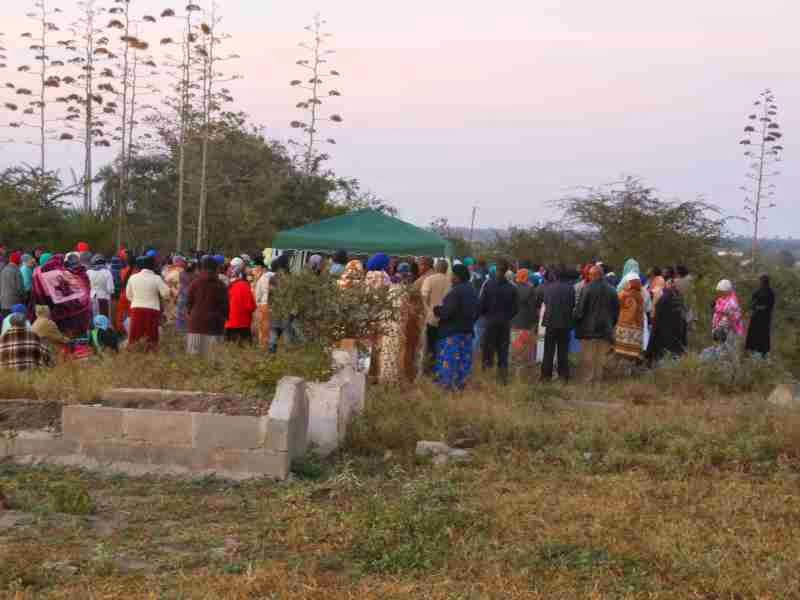
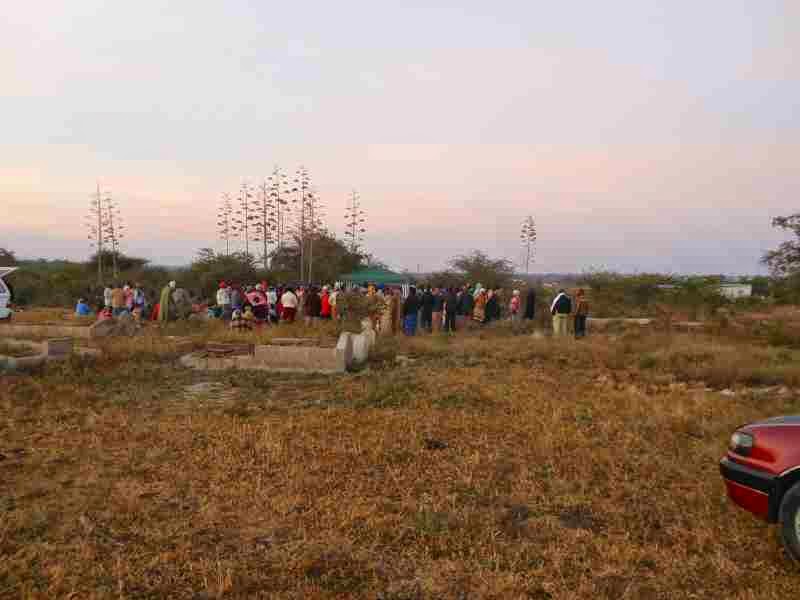
    The body was then carried to the back of a pickup and driven slowly to the nearby family grave-site, and the body was lowered into a grave, carefully lined with grass mats, as the sun peaked over the horizon. Prayers, hymns.
    I had to leave to get up to Mbabane to try to get on one of the 3 computers at PC headquarters available to PC volunteers to put out the monthly PC newsletter; I took these picture as I left.


It was chilly – low 50s (F).


    Walking in the early dawn the 1 1/4 miles to the bus rank, I was moved and thoughtful at the beautiful burial at dawn. I am put off by many religious practices in this country: the length and, with electronic magnification, the volume of religious services in a language I barely understand even when the acoustics are ideal; the preaching has an angry tone, although the few times I've been able to understand the words the actual meaning is more determined than wrathful. But this service was beautiful and moving, and just right for me. When my time comes, were my services timed the same, I'm sure attendance would be significantly reduced, but those who came, if the dawn were as perfect as this one, might be gratified.