Saturday, October 5, 2013

pix for the previous blog


Here are the pictures I could not send yesterday. This shows the two 2-year old girls who live at our homestead, with the mother of one of them, the domestic worker employed by the family. The girls are mimicking with their stuffed animals the way the moms tie babies to their backs with a blanket. The bare earth compound around the houses is customary in southern Africa; with the warmer weather and rains the snakes will appear, and they stay away from houses where they have to cross a lot of open space. Water barrels filled from a metered tap are behind them. The banana (visible), orange and avocado trees (not visible) grow right by the water-filling and washing area, where they get some water during the dry winter.


I mentioned in an earlier blog about the primary school where parents are helping build 3 new classrooms. The completed the foundation this past week; with this kind of parent involvement, public finance as practiced at Sherman and Howard is unnecessary! When I set up for the picture they assumed I would want Phumi pushing the wheelbarrow. The woman guiding the wheelbarrow – in the skirt and slippers! - had been pushing it.
 
Thanks to those who have responded to my plea for biblical references - these will be very useful!  Other ideas will be appreciated, too.
 

Thursday, October 3, 2013

Need help with Biblical references, + an alternative to public finance


It turns out that some of my blogs have been of interest to the residents of a Quaker senior living community in Philadelphia where my cousin Cathy works as a social worker. Cathy's seniors asked about the religion in Swaziland, and I'll provide what I can on that, but first, I have a request to those reading this blog who are learned in either the Old or the New Testament, for some help with useful Biblical citations.


I'd like to use Biblical references to make some points to my Primary School. Every Wednesday morning at assembly one of the teaching team “ministers” (preaches) to the students, and I've been asked to do that. Initially I begged off, because the PC doesn't want us to proselytize, because many PCVs aren't Christian – we've got 2 Muslims, at least 2 Jews and probably more, in our group of 33. But the young man who preceded us here, who was enormously loved, was LDS (Mormon), and he “ministered,” and I got to thinking I might have a “bully pulpit,” if I could firmly ground my lessons in the Bible. But my Biblical knowledge is a little sketchy, which is where Cathy's seniors and other Biblically learned readers might be able to help.


Can you give me Biblical citations that might be useful? I'm initially thinking of stories of strong women, as leaders, thinkers, doers. Not so much Ruth (“Whither thou goest, I will go, thy people will be my people”) - these girls get that in spades. And not Mary Magdalene – the fallen woman. Is there someone like David vs Goliath, but female? Or Solomon? Delilah was clever (shearing Samson), but I don't think that's quite the message I want.

Then, how about accepting people? Isn't there a passage where Jesus goes among the lepers? Boy would that come close to what we have here. Where can I find that? I need to be a little delicate; during these beginning months, as I hope to build up some local credibility, I'm trying to be careful and conservative, hitting for singles and maybe doubles, not home runs, careful not to offend the people I want to be persuasive to for 2 years.

And how about children as being worthwhile, themselves. Where can I find “Suffer the children to come to me, for of such is the Kingdom of God?”

Maybe if you just send me the citations by email (markLfulford@gmail.com) (We get pretty good service receiving email early most mornings – can't always send.), I can find them in the English Bible they use here – I'll have to borrow one – didn't bring one.   Or, if you can copy them as a PDF attached to an email, I can probably download them on Tuesdays when I get some low cost moderately fast internet service through the village library. Or post them as a comment, if that is easier or might be of interest to other readers – we could instigate a theological discussion!

My cousin Cathy's seniors also asked about the religion here, and I've picked up some, but the services are mostly in siSwati, although sometimes they translate the readings and the sermon for us. And the PC, as part of their careful and well done acculturation this past winter, gave us a lot of background on local religious practice, because religion is so important here, and plays a role in battling HIV (generally the churches urge abstinence but discourage reference to using condoms, claiming condom use promotes promiscuity; there is a lot here of what are called “multiple concurrent sexual partners,” regardless of condom use.) Swaziland is very Christian – around 80%, although I'm told only around 40% of that number regularly attend church. The religion is predominantly pentecostal Christian: African Evangelical Church (“AEC”), “Jerichos”, Zionists. We've encountered one Roman Catholic person, and spotted 1 “Anglican” church. The emphasis I find is on having faith, and loving God, and that way you will be saved. There is much about “the End of Days” and the coming Judgment. I've heard nothing at all about the Virgin Mary. And no instruction that I've picked up about living a Christian life: nothing of “love they neighbor”, or the Good Samaritan. The instruction I've heard is to believe, pray, love and praise God, have faith, as far as I can pick up. And the preaching has a really angry tone; kind of frightening, maybe just because I don't quite know what is being said. The readings seem to be mostly from Revelations and, in the Old Testament, from what I think is called the Pentateuch, the first 5 books of the Bible.

The singing is really good, although the patterns are quite repetitive, and the churches that have sound systems keep them at their loudest level, which I find deafening to the point of being painful in these relatively small enclosures with hard walls and roofs.


Here are the two 2-year old girls who live at our homestead, with the mother of one of them, the domestic worker employed by the family. The girls are mimicking with their stuffed animals the way the moms tie babies to their backs with a blanket. The bare earth compound around the houses is customary in southern Africa; with the warmer weather and rains the snakes will appear, and they stay away from houses where they have to cross a lot of open space. Water barrels filled from a metered tap are behind them. The banana (visible), orange and avocado trees (not visible) grow right by the water-filling and washing area, where they get some water during the dry winter.   SORRY - CANT UPLOAD PIX - WILL TRY TUESDAY FROM THE LIBRARY.


I mentioned in an earlier blog about the primary school where parents are helping build 3 new classrooms. The completed the foundation this past week; with this kind of parent involvement, public finance as practiced at Sherman and Howard is unnecessary! When I set up for the picture they assumed I would want Phumi pushing the wheelbarrow. The woman guiding the wheelbarrow – in the skirt and slippers! - had been pushing it.

Tuesday, October 1, 2013

Homestead visits, grass mats, and a church wedding


During the 3 month “integration period” we are in now we are not supposed to be working on our “primary projects” (although I've started teaching – they wanted me to, and I really wanted to get on with it – nice to have a structure to my week; Phumi is a little envious – in a nice way), but instead we are to get to know the neighborhood. During training we learned several techniques to do this, and they really do help you peel through the layers of a community very different from where we come from, and they also help get us out of our hut and meeting with people. A major getting-to-know-you technique is the “homestead survey,” involving visits to each homestead in our community, asking the same questions, accompanied by a local “counterpart”, who handles introductions and translation.

Phumi is assigned to “Community Health” (I'm in “Youth Development” - the 2 areas overlap, and I see us crossing over a lot), and so she works with 5 women who are umgcugcuteli, or Rural Health Motivators. For US $30/month these women visit around 25 homesteads each and try to educate them on sanitation, hygiene, disease prevention, and the like. Invariably these women are highly knowledgeable, deeply committed to their task, trusted and beloved by their community, exhausted caring for their grandchildren and additional “Orphans or Vulnerable Children” (an official category because school fees are waived for OVCs, sadly very numerous), and living close to the edge of poverty. And sometimes over that edge. When Phumi met her principal contact among the RHMs, the umgcugcuteli's home had been robbed, stripped bare, probably by young men seeking money for “dagga,” a strong form of marijuana that is one of Swaziland's principal exports. Her daughter could not go to school because her shoes were taken.

At these homesteads we meet the living face of this country's failed economic and health system, and see in front of us the human toll, at an individual level. At any given time I'd say the inhabitants of maybe 20 % of these homesteads are hungry. When we've finished asking how many adults and children live there, how many go to school or are employed, whether there is a latrine or a source of water on the homestead, we ask if anyone on the homestead is HIV+. Most homesteads have someone who is, and the RHMs know that; occasionally we get a response that they don't know whether someone is positive, or, more likely, not all the people there know their status. Then we ask if they have questions for us, and typically they ask us for money. We could relieve their hunger temporarily and not notice the expenditure, but, fortunately, the PC forbids outright gifts. Once you start that in a community, you'll be asked even more frequently. And a fundamental PC goal is “sustainability:” “give a man a fish, you feed him for a day; teach him to fish . . . .” These encounters are draining, emotionally and physically.

Here we are interviewing 2 different homesteads, both among the more prosperous of the ones we visit. At the first the man questioned us closely about why the US isn't stopping the war in Syria, and was very enthusiastic about Pres. Obama. The 2nd picture shows in the background one of the houses they make of stones held together with rows of parallel sticks wired together. Strong, but well-ventilated.

 
Our household is composed of the father (“Babe”, age 71), his wife (“Make” around 65), and his brother's widow (Gogo, around 80). Make weaves grass mats on hot afternoons on their porch, which is directly opposite our front door. The 2 little girls who live here, her granddaughter and the domestic helper's daughter, are also in the picture. Both Make and Gogo have diabetes, which is impairing their eyesight. Diabetes is common in this country, especially, I believe, among older women, I think because of their diet. In training we learned that having HIV is preferable to diabetes in this country, because the insulin for diabetes is not as readily available and has to be refrigerated and the injections are hazardous.


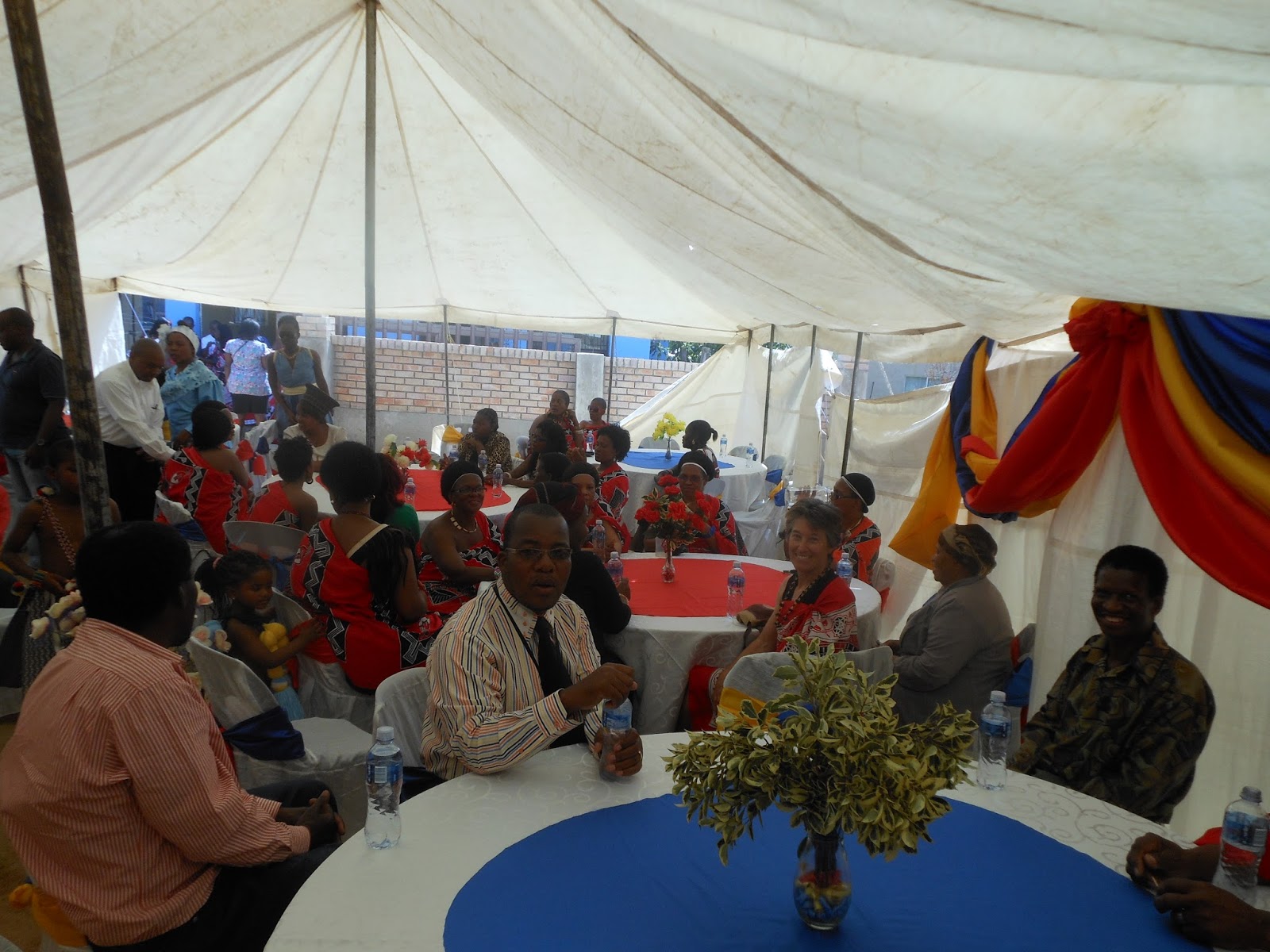
Sunday 9-29 we were invited to a local church wedding by the PC staff member whose family

live in the area. The wedding was scheduled for 10 a.m. in the very impressive teepee-shaped village “community hall” which is “the Agape Church” on Sundays. My Swazi PC boss is active in the church and helped organize the wedding. Only a few dozen people were there when we arrived as instructed at 10:30; it started shortly with the “Praise Team,” 1 woman soloist after another coming to the mike to lead the hymns, till there were 6 of them up there, doing harmony and backup. We were ushered to a seat directly behind the bride's (I'm pretty sure) family, sitting, we were told “with the elders.” Oh, OK. By 11:45 there were 300 people there. We were introduced by name; we'd previously met the pastor in going around the community. After much singing, praying and sermons, the wedding wound up with a generous meal at 2:45. I thought the children clustered around me as I ate wanted to take my plate to help pick up, until I remembered a similar circumstance at the primary school a few wees ago and was careful to stop eating in time to leave some scraps on my plate when I handed it to a watchful little girl. A boy bigger than she scraped my scraps off the plate into the plastic back he carried for the purpose and made off.

This picture shows the bride, groom and wedding party on the decorated dais, and the “MC,” a staple at Swazi weddings, invoking the deity' no doubt.

Tuesday, September 24, 2013

Bird Pix


We have located relatively fast and reliable, cheap, and relatively accessible internet! The couple who proceeded us here reached out to us through Facebook and we've now exchanged messages and received much useful information, including that the town library, which we hadn't yet discovered, has inexpensive and relatively fast internet service.

There were some pix I liked from our break at Mabuda Farm that I couldn't send because we had to move fast on their more expensive internet, so I'm attaching them now.

A crowned hornbill is at the bottom of this picture:


(Its really hard to aim this little cameras, with the telephoto all the way out.)

A white chested, shiney-rumped balding buzzard (quite mature plumage, definitely not breeding season) was sighted:

We also saw a splendid striped kingfisher and black-headed herons – not new to us, but good views of stunning birds.

Phumi on our beautiful veranda:


Back home, we walked over to the high school to see the election. We were told that 250 had voted there in the morning, but when we got there in the afternoon there were many more officials than voters. In fact, the only voter we saw was turned away, because she was registered at a different polling place, maybe 7 kilometers away.

The highest official summoned me over, asking what kind of “observer” I was; I assured him I was the most unofficial kind there could be – the PC does not want us involved in politics in any way.

Friday, September 20, 2013

PTA, Duelin' Pastors, and a break


Just a communication note to our friends. We now can receive email most mornings, and we've loved the news from some friends about babies, weddings, children, trips, and, so sadly, the devastation in Colorado from the deluges. We can sometimes send emails. We can only rarely open attachments.


In our continuing effort to get out into the community, get to know it and introduce ourselves, we learned of a new term parent meeting at the nearby Primary School (not mine, which is the better funded Railway Primary School, but the one (inadequately) funded only by the government. We showed up and, as typically happens, they were delighted to see us, sat us up front with the School Committee, and were very gracious. The meeting took place under a tree in the school yard. The main topic of discussion was how to fund an expansion, because the 5th grade has 70 students, all crowded into one classroom. The solution was to have the parents show up once a week to work for a morning to help build the new classrooms. A long and fairly animated discussion followed on what amount should be paid by those who do not work. The School Treasurer's proposal of US $5/week was defeated and the decision was US $2. This was all conducted in siSwati, but we got the general facts.

Men do not wear hats at official occasions, women must wear hats. An unfortunate consequence of sitting with the Committee is that we were in the full sun for the 3 hour duration of the meeting, and I got some dehydration and heat nausea, and I was glad to go home and crash. Better the next morning.

When we stopped by the School Monday morning about 30 parents were sitting under the tree, watching a power shovel dig out the foundation.

We learned that, in preparation for the elections in 2 weeks, all the churches in the county assembled at the Chief's house – effectively the county seat – for a common church service. The bus to the service was to leave at 9, we arrived at 9:30 and it had left, or never come, but a man in a private car offered to drive us there (it was probably 4 miles away) for US $1. KUF knew the bus rate was 40 cents, and beat him down to that – he never had a chance.

The service was to start at 10, and when we arrived there were around 8 pastors and a dozen other worshipers. We introduced ourselves. By 11:30 the hall was SRO, close to 300 congregants, more than 3 dozen pastors (around 8 of them women), a youth choir in robes, an organist on an electric keyboard. After some hymns featuring some female soloists, each of whom seemed to try to be more intense than the previous one, one pastor got up to preach, at length, then another, not to be outdone, at greater length, with more fervency. In between, hymns which brought some parts of the congregation to their feet shouting and waving, but left others motionless. The man in front of me sat with arms crossed and head bowed through the entire service, except for one hymn that brought him to his feet. Towards the end of each sermon each pastor would close his eyes, raised his hands, and, I am pretty sure, start to pray (I can recognize a lot of the words because they are also common first names – mine, for instance: “Sipho” = gift. Until I figured that out I wondered whether it was a good thing that I was mentioned so often in prayers.) As the pastor's prayer progressed, many in the congregation – no doubt particularly from his denomination – would start to pray as well, but unlike the singing which was astonishingly polished even as it seemed extemporaneous, the praying was all on an individual basis. I sensed some gentle teasing during some of the sermons, perhaps from rival pastors, but the interpreter whom the moderator had arranged to sit between Nomphumelelo (sometimes shortened to “Phumi”) and me assured me they were in agreement. Nothing metaphysical like, say, transubstantiation (you could look it up, because you have high speed internet), more a matter of how each church described how awful Satan is, I think. During the scripture reading the designated interpreter followed each line of text in siSwati with an English translation that sounded pretty close, read to the whole congregation, but useful only to Phumi and me. Deuteronomy, and Revelations – that's part of the Apocrypha, right? Not even in the King James Bible, I believe. Lots of devils and burning in hell, from what I could tell.

The service lasted 3 3/4s hours. I'd love to have had a picture inside, but all I felt free to snap was outside, afterwards, Phumi with one of the ladies who is introducing her to the community. More on these “Rural Health Motivators” in a later post, because they are extraordinary.


We were to submit a report on our initial settling in activities, and we got it done early, because of uncertainty about how well we could submit it by email. I wanted to then get away to a B&B on an old farm originally built by a mining and sugar magnate from Jo'Berg 80 years ago, on a hill 20 k away. Phumi wanted to stay and interview some more pastors and makes in destitute homesteads. So here we are at a beautiful cabin on a dairy farm kind of reminiscent of Vermont, and it has high speed internet so we got our reports off! And we've already seen a long-crested eagle, a white-eared barbit and a crowned hornbill (all new birds for us!), some magnificent black crowned herons, and some other interesting big and colorful birds we haven't been able to identify yet. Then a swim, a walk as the sun sets, some wine with dinner tonight, watching the full red African moon (yeah, its always red as it rises and sets, I think because of the wood smoke and dust in the atmosphere – never fails to stun me when I see it), catch some more birds Friday morning in a wooded ravine down from us (“Grandpa's Garden – this property has been in one family for generations), then to back our site, which is not quite as comfortable.
 

Thursday, September 12, 2013

Getting down to work


The attached picture shows Mark about to head off for his second day of teaching, as he was being advised by Katherine to avoid stepping in poop. Aside from being a necessary precaution every step around here, this was a family echo of one time when I walked our children into school for their first day. An unfortunate misstep in the park that that day that followed me to school and even to the office, became a theme on other recurrences of the first day of school, through the years. I'm sure they also remembered through the years the useful wisdom and sage advice imparted that first day of school, just as vividly.


After “assembly” at 7:30 a.m.at my school here in Swaziland, the teachers spent 15 minutes “settling down” the children in their classrooms, and then every single one of the teachers adjourned to an all morning faculty meeting, leaving the children in the classrooms with no adults and nothing to study. My class was to be ½ hour starting at 11, but after the ½ “lunch” break ended at 10:30 I excused myself from the meeting, which by then had mostly lapsed into siSwati, and bravely entered a classroom of 41 sixth graders. The PC trainer had taught us to try to get an opportunity to prepare the teaching environment before the students arrive, but they were fully in possession of the premises, and watched in amusement as I pulled out my various supplies. They were attentive, and anxious to please, when they could get past the language barrier and figure out what I was asking. We talked about long-term goals, to lay the groundwork for next week on short-term goals and challenges. Many want to be doctors, mechanics, engineers. No one mentioned being a husband, mother, father, wife, son, etc. Maybe because of how I posed the question? When I finished the discussion of goals they could see we had time, although my ½ hour class period had expired, and they said they had questions for me! After I understood what they were asking, and the particular questions, it was revealed that I don't know JayZ, I have (sort of) met Pres. Obama (well, there were around 79,999 other people there at Mile Hi Stadium), that I have 2 children, and they are too late in seeking to marry my daughter. I said I would tell them how long I'd been married . . . some other time. Isn't the old Las Vegas showman's expression – leave them wanting more – applicable to teaching 6th grade?

I've had some contact with our son and daughter-in-law as they've prepared for teaching graduate students and undergrads. I bet they had better classroom management skills than I did my first day, but not for lack of effort and attention on my part. I'm not sure I saved anyone from HIV yet, either. I'll be with this class a full term, till December, so there is a little more time yet.

The picture is in our living/kitchen room. Propane to the left, water filter to the right. Kind of like the 10th Mtn Division Cabin. But much smaller. The table, chairs, and shelving on the left were left by the previous PCVs, and not appropriated by the host family.

While I was at school Katherine was to meet one of the 5 “Rural Health Motivators” in the vicinity, who was to take Katherine around to meet families in neighboring homesteads. During this 90-day “Integration Period” we are in now, one of our big tasks is to take a “census” of the community, listing the people in each homestead and noting how many orphans (some in every homestead), children in school, people who are HIV+ (you don't always get the truth on this one – kind of hard to ask, but the RHMs are a really good entree), whether they have electricity, water, a latrine (some don't). how they are employed outside the homestead(so far maybe less than ½ the adults), some things they like about living here. How we were to do this community survey had been a puzzle to us, but Katherine walked with one of the RHM's to one homestead after another, until around 2:30. With no appointment they just walked up to the homesteads and sat down to get to know them.

The RHM's are (barely) paid by the government to provide instruction and some care for people in outlying areas. They are typicallyly women in their 50s or 60s. They know and are welcomed by everyone, and are remarkably well-informed about health matters. They are the perfect key to the community.

This required “Community Assessment” is a little “make work,” in the sense that there is not a big need for the data we assemble. But the process of visiting each homestead gets us out and meeting people, and gets us known by them.

There are “single” and “double orphans in every homestead. The concept of “single” orphans (lost one parent) is important because children who have lost one parent are far more likely to encounter problems – health, academic, social – than children with 2 parents, even when they are mostly raised by both parents. The prevalence of children being raised by their grandparents reminds me of some drug- and crime- afflicted US inner cities, and hints at the pain and loss we felt among young adults in Cambodia when we were there in 2006, who had been raised without parents, lost in the Khymer Rouge genocide in the 1970s after the US left Vietnam.

Wedding in SA, and then a sudden loss


When we arrived August 30 at our permanent site we were repeatedly asked to join our host family at a wedding of our Babe's (head of household) niece in Barberton SA, a mining and agricultural town NE of SZ. We received expedited approval from the PC Country Director to leave SZ, and left at about 5:30 PM Friday, 9/6/13, but not before one of the family's goats had made his ultmate contribution to the festivities to nourish the dozen on so friends and family who came to the homestead Thursday and Friday. We'll try to include a picture of butchering and cooking. Unfortunately, we missed the call for dinner, and by the time we arrived only the parts involved with locomotion and digestion remained. Turns out goat is really tough, and . . . gamey. Probably an acquired taste. We've got 2 years. Vigorous brushing and flossing helped.


It should be about a 2 hour drive to Barberton, but there was a mix-up on the paperwork and we had to go by a 5 hour route through a different border crossing. The border closes at 8 PM. After much stress we got through, hearing the barricade slam shut behind us as we walked across with about a minute and a half to spare. The bride was with us, so they needed to get there. The hired khumbi was crowded and hot. We arrived at the bride's family's home (actually here daughter's home) around 11 PM, and they produced buckets of Kentucky Fried Chicken, ubiquitous here, and the Swazi omnipresent staple lipalishi – like grits, but with less flavor. The family had arranged for separate houses for the men and women, and we spread out on foam mattresses on the respective floors. We had not known what to expect or what to bring; we were glad we'd brought our sleeping bags.

We had heard that South Africa generally is notably more prosperous than SZ, and this visit was consistent with that. The houses we slept in had hot showers, kitchens, microwaves, indoor plumbing – these houses would have fit easily into Crestmoor Filing 2, except for the walls around the gated community and then the separate spiked fences around each house. The community was mostly white, from what we could tell.

The PC had been at pains to help us understand important aspects of Swazi culture, particularly marriage, but I'm not sure we have that system entirely figured out. This step of marriage is the final one of a long process, and seems to occur after the groom/husband has saved enough to pay the “lobola” = “bride price”, currently around 18 cows, we understand, to the bride's family. This couple were in their 50s, grandparents; their oldest child is 34. I assume some equivalent for the cows was tendered, or they were kept elsewhere, because this was a housing subdivision, and there was no place for livestock. We understand that there were also at some point both civil and church ceremonies.

Because of the border crossing timing issue our Babe was anxious for the in-laws, putting on the wedding, to keep it moving along. He'd have been as productive pushing on a wet string. “Swazi time” applies, even among Swazis living in SA. One of the “bhuti” (brothers) joked that the in-laws were ½ Swazis, but the men who heard the remark suggested it not be shared with the in-laws.

After a delicious and bountiful breakfast we assembled at the house the bridal couple is just completing. A major part of this wedding stage is the bride's family giving gifts to each of the in-laws. The gifts were typically blankets, grass matts, or grass brooms, brought from SZ in a pickup by one of the bride's cousins.

Many of the men wore the lihiya, traditional dress. I wore traditional US wedding dress, although my bow tie was fabricated from Swazi print material. Katherine wore her “little back dress”with a lihiya tied on top.

After the gift giving all adjourned to the nearby tent, carefully decorated by the bride's family. I sat at the men's table and was, of course, served first. Nomphumelelo was at the most senior women's table, and refrained from bringing me my plate, to the amusement of the men at my table, but one of the in-law sisi (sisters – all-purpose terms for young women) made sure I was well taken care of .

During and after the meal there were numerous hymns and prayers, including a vigorous blessing by the 5 pastors in attendance from the bride's side, and some generous gift-giving to the newly-weds, including a slow-cooker and an electric bidet.


After the meal the bride's family dismantled the tent decorations, packed them and us in the khumbi, and we headed back across the border, making it in plenty of time. There was no alcohol, except for a bottle that looked like Chivas (!) shared among some men in the back of the khumbi. It wasn't offered to me, and I did not ask. The only music was the hymns, mostly from the (very religious) bride's family. No Western style dancing, though during the gift giving part the women sang and kept rhythm with their feet. Some had on shell ankle bracelets which made rhythmic rattles.

The morning after the wedding the homestead was very quiet as everyone slept late and visited quietly. We too have twice had those “it's all over” blues. Midmorning the family got a call that a cousin had “unexpectedly” died, and there were some issues on caring for the child of the marriage. This lead to a discussion between KUF – whose cross-examination skills should be required instruction for trial lawyers – and the domestic worker at our household, that the cousin died of complications from AIDS and that several members of our household are HIV positive. The PC has taught us that, with advances in medications, people who are HIV+ can live out a natural lifetime, although HIV can't be cured, and a panoply of drugs must be taken meticulously and have some side effects still being discovered. Everyone on the homestead was subdued and somber. Visitors have come and gone. We've mostly stayed out of the way. It was a good day to try the electic hair trimmer I bought; probably best to wait a few weeks before sharing pictures of the result. We are developing many useful new skills.

Uploading pictures to our blog is lengthy, expensive and uncertain because we keep losing our connection, when we can get one at all. We plan to take the computer into town where we understand there is free internet, and there we may risk trying to include some wedding pix with this narrative. Or we may get the narrative off and then send each picture as a separate post. Sorry if that is cumbersome to deal with. We can get and open email early each morning; we haven't enough connection to open attachments – pictures and documents. We'll try when we go into town.