Monday, November 11, 2013

Tailoring, diabetes, and the Principal's Office


Last week Mark had some pants and jeans altered. Our friend Daniel in the cluster of shops at the crossroads took in the waist of 2 pairs of pants and shortened my new jeans, all for US $5. Services in this country cost nothing. Daniel took just over 24 hours, because he was very busy preparing the gowns for the pre-school graduations, which are a big deal around here. Here is his shop.


We have been struck by the prevalence of diabetes in our communities, both during initial training, and here at our permanent site, especially among women over 50, and we had wondered whether some targeted health education might bring big returns. When we heard that one of the PCVs whom we like a lot from the previous group (now 17/27ths into their 27 month service) had organized a day of instruction and demonstration on preventing diabetes, we took an early morning series of bus, khumbi, and hitching rides 30 miles back to the west and attended the days event.

90% of the diabetes here is type 2, resulting from excess body weight and physical inactivity, similar to what is found in some inner cities in the US. So the focus was on nutrition and exercise.

The event started with a march, complete with drum majorettes from the local primary school, and then a session of aerobic exercise. We helped prepare a healthy lunch of locally sourced healthy foods that are within the Swazi food preferences.

We may try something like this in our community, although the “counterpart” (Swazi involved in the project) for the event we attended is the daughter of the president of the nascent Swazi Diabetes Association, and was extremely enthusiastic; we do not know of an equivalent counterpart for us in our community. We are learning that the best projects are ones originating from the enthusiasms of the counterparts, not the volunteers, because the counterparts will work on and bring their friends into projects in which they are interested, and those projects meet the PC “sustainability” goal. We are now at the stage where we are planning our work for the next period, and we are exploring what we will do. We know we want to teach at all 3 local schools, one affluent primary, subsidized by the railroad, and another primary and the high school, the latter 2 severely under-funded and lacking in many areas. We plan to teach “life skills,” including goals, decision-making, self-esteem, nutrition, and sex and safety information. We are having a lot of success, we think, with team teaching, and this enables us to separate a class into boys' and girls' groups, get and give candid answers and information, and then sometimes compare for the whole class what the different groups were thinking.


Here is a picture of Katherine waiting outside the High School Principal's office. No, she hasn't been bad; we are waiting to see him to try to pin down exactly what we will do at the High School next term, starting in January; we need to coordinate subjects and schedule among the 3 schools – they are several kilometers apart, and we walk everywhere. We also need to get his authorization to bring a “counterpart” to training in December.
 
sorry, I think the pix got all mixed around, but this connection is so slow, and I forgot to bring the wireless mouse Martha and Tyler got us with the computer, and I can't get them straightened out.  Sorry.
 

COMING HOME

We were welcomed back into our community after being gone for almost two weeks of training,
and it felt good. We ran into friends, students, teachers, and bomake (women vendors) at the local shop and on our long walk to our homestead with heavy packs who greeted us by name and asked where we'd been. One of our favorite high school students Joanah gave me a big hug and said she'd missed us. With somewhat improved siSwati, we have been able to communicate better with out host family. We are the only white people (balungu) in our community so it is easier for them to remember us than for us to come up with their names, quite often. Sometimes I have to ask how a person knows me, but I recognized by name an English teacher from the high school who was on our return khumbie.

One of our personal goals in joining the Peace Corps was to become part of our new community; to become friends and neighbors to those living around us. I hope we will do meaningful work here, but it is the one-to-one connection with people, sharing the good and bad, which will have lasting value. My Site Support Agent, Sizakeli, an umgcugcuteli or Rural Health Motivator, joined us for lunch yesterday. She had showed up 2 hours early for work at the kitchen of the high school just opposite the gate to our homestead, because she does not have a watch and lost her cell phone 2 months ago, and we were coming back from a walk, so we invited her in. She is a poor, hard working woman with 4 children, and a deadbeat husband whom they haven't heard from for years. She has a gap-toothed grin, is cheerful, savvy and resilient. Over French Toast (a first for her) we talked about commercial sex workers, handing out condoms and religion. She is a devote Jericho. Sizakeli told me she would cry when I leave, because we are good friends. This is beginning to feel like home.

Sunday, November 3, 2013

Halloween


So most of our group and the previous group got together at a “backpackers” hostel near Manzini and near the training facility, for Halloween (actually, the weekend before Halloween). It was really fun.

Our day started out early, because we wake up early, and headed out and, just as we stepped off our homestead, weighted down with full backpacks with clothes for really hot and quite cool weather, computer, and language books, a small pickup stopped to pick us up on the 2 K walk up to the main road – really nice. Only 2 kids already in the back and no dogs, and the truck bed was pretty clean – a very good start! And as we got to the bus rank at the junction, a partially empty bus was about to pull out, so we got to get on with our backpacks, which meant the backpacks didn't have to go in the boot where we couldn't see them – with the computer that prospect had made me a little uneasy. And a little bakery where all the PCVs assemble near the Manzini bus rank was open, and we had a delicious breakfast there and visited as our group started to arrive, did some shopping and took a short khumbi ride to the hostel.

The hostel is a sprawling old house set back from the main road among some trees on a hillside. Most of the PCVs stayed in bunks in a co-ed dorm for US$12 each, but we splurged for US$15 each and got a separate little house all to ourselves – with a lovely hot shower and a sink, with hot running water and a mirror. You could also camp on a grassy lawn for US$8, and some put up tents, but it rained from 3 until around 9 PM, and they all moved inside and crashed on mattresses in the lounge.

Here we are, as we left, on a gray chilly Sunday morning.


It was really nice to reconnect with these kids and hear how they are doing. Its hard out there, and some of the most capable are having a hard time, just because they are in difficult situations: remote and can't get around well, or far too much to do and not enough help at an orphanage, or trying to teach 5th grade math to deaf students using sign language – in siSwati! Yeah, the thought of even trying that dumbfounds me. There are some really smart kids here. Really, really smart.

The PCVs got dressed up in very clever costumes.


Mark is on the far left, back row. Middle row, standing: a mosquito net, then a Swazi school girl in school uniform, an 80's workout instructor, cat woman, a greek goddess, spider woman, a 60s hippy. Front row, kneeling: Not sure who the 1st person on the left was trying to be; then Pocahontas in a clever costume made from a slip and parts of old mosquito netting; Pipi Longstocking, and a “Care Package” - my favorite.

Mark went in a double costume: a scary old guy wearing the attractive hair extensions frequently worn by Swazi women, which were then removed upon request to reveal an even more scary Swazi haircut, now 3 weeks old and still showing parts that had never previously seen the sun. KUF wore a pink spotted dress and was the elusive pink spotted leopard..

Rumors Sipho danced on the bar, wearing a wig, joined by a scruffy guy with a moth-eaten beard wearing a red dress, are false and have been referred to our solicitor for an appropriate response. Well, OK, there was a small wall near the bar, I admit that. And there may have been some tastefully arranged hair extensions. And Abdul is a PCV (Yup, Abdul Ahmed – Muslim, from Oklahoma – ah, the diversity of our country!) from the previous group who has helped us with some lesson planning and whom we like a lot, and he looked really good in his girlfriend's dress. But dancing on the bar, like some kind of inebriated college kid? Nah.

Now we're back at the training facility, settling in for intensive language instruction and a “resource fair” later in the week with vets from the group that has been here a year showing us what materials can be helpful to us for lesson plans and youth group activities that have been loaded onto a flash drive and onto the Kindle the PC issued to us. And pursuing mutual exchange of resources – I've been getting some fine tunes from some of these kids – exploring new areas. Plus of course, exchanging movies. Don't tell ASCAP. The technology issues are daunting, but we're getting better – some of the other PCVs are very patient and helpful, and I'm getting exposed to lots of music that's new to me, including South African – Ladysmith and Xhosa, and the Vitamin Quartet and Civil Wars. It's taken me 3 or 4 efforts to learn the multiple steps involved (you can't copy directly from a flash drive into iTunes; you have to copy into My Music, then open a new folder in iTunes), but I'm now successfully downloading to the computer – its really complicated. Aren't you proud of me? Of all the challenges of this PC endeavor, the technology is right up there near the top. Where's the Sherman and Howard Help Desk when I need them?

Well, so far there is no WiFi at our training facility, so I'll just keep adding, because I can't send this out. After sitting in classes all day Monday and way over-eating because . . . well, the food was there, we didn't have to fix it . . . , anyway, some of our group were doing the “Animal Flow” exercise cycle Monday evening (pictured, MAYBE) and then some of us got up at 5 a.m. Tuesday to do the “Insanity” workout Katherine's walking group friends had sent us (also pictured; we understand there are some who have come to anticipate – is that the word? Dread? - the repeated topless pix of Mark. Kind of like a centerfold, or when the Sports Illustrated February bathing suit issue came out and immediately disappeared from the magazine stack at the gym.). We all go to sleep so early at our homesteads, and we're doing that here too (except for Saturday night, when we partied), and so we wake up early, so that wasn't as tough as it may seem in US terms, at least for some of you. Its a good workout – I'm still sore! Thanks, friends.

 
Lots of training during the week on language, teaching skills, and what we need for a successful project. Saturday morning we were unscheduled, so we went back to the homestead where we had lived in July and August during Pre-Service Training. Well into the spring now, it is all green and very beautiful there, and the avocados, mangoes and peaches are developing on the trees, but won't be ripe until later in the summer – January or February.

Wednesday, October 23, 2013

rain and packages!


We had heard that it can rain hard here in the summer, and that the spring rains are late this year, which is a serious issue in a region where there is much food insecurity. But we were not prepared for the rain, which started Thursday evening, and continued for four days, until Tuesday morning, sometimes just spitting, sometimes coming in torrents. On the corrugated metal roof of our hut it was sometimes deafening.

We had planned to go on Friday to a game reserve 30 miles away, but awoke to a continuing, driving rain. Pretty much the same Saturday, Sunday, and Monday. We never really left the hut. When we did we had to pick our way around increasingly deep puddles. You really plan your trips to the latrine – 50 yards away – under those circumstances. Sometimes the clouds would part briefly, then it would suddenly cloud up and pour. KUF stayed after a meeting at the local high school on Monday to try to get on the internet at their computer lab, and got pretty soaked on her way home.

The picture shows our homestead Tuesday morning. A sea of mud. The domestic helper tried to fit a wash into a brief opening Monday – no luck. Our hut is behind me; the main house is to the left of the picture.


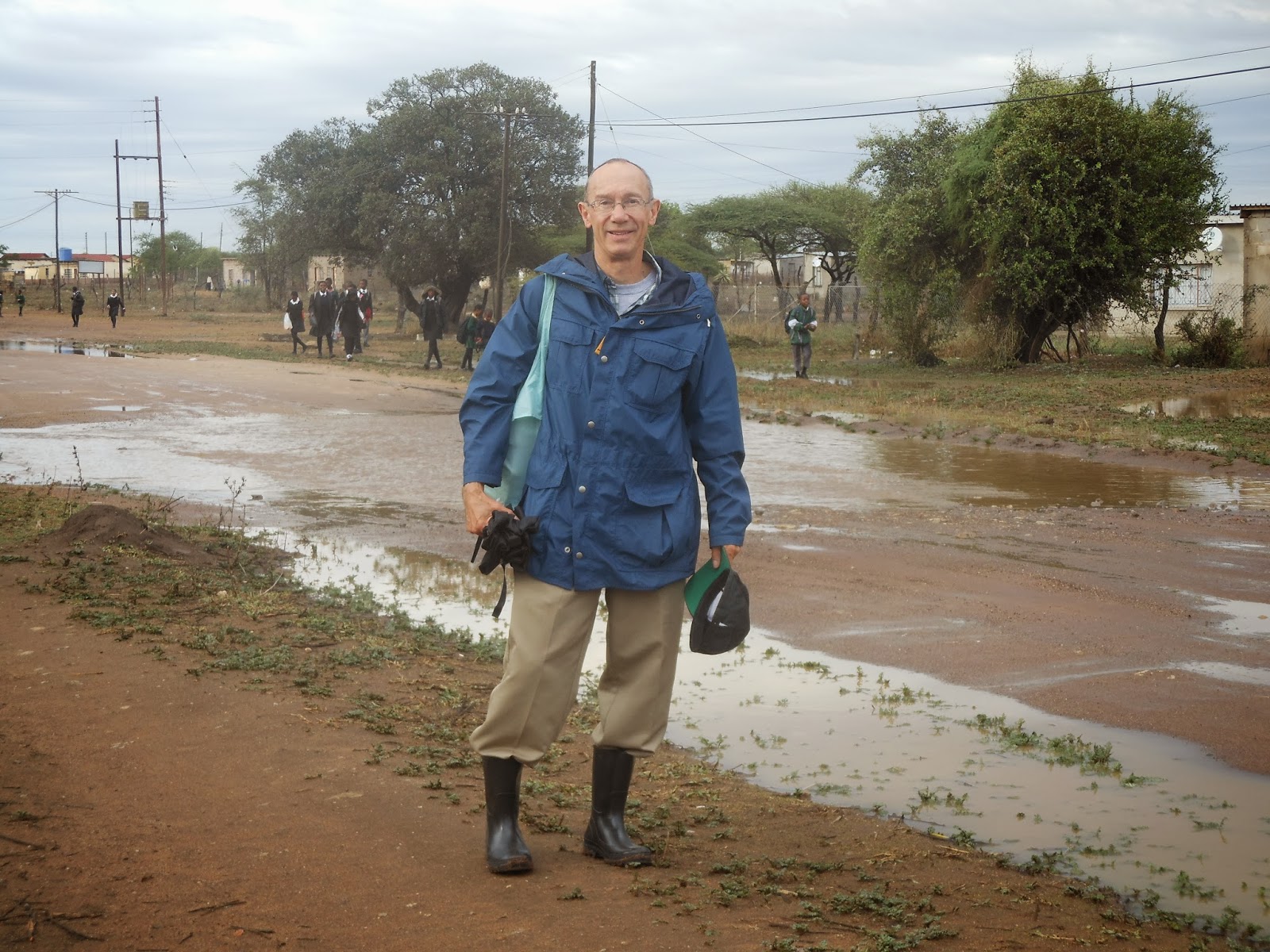
And this shows me on the 1+ mile walk to the crossroads. We pass dozens, perhaps hundreds of chldren on their way from the bus rank to the local high school and to a primary school different from the one Mark teaches at. We bought the rain boots a few weeks ago in our local shopping town. Glad to have them.


We've now been in at least 2 classes at each of these schools, and we are fairly distinctive here, so many of the students we pass on the road know us, and some greet us by name as we pass, or just call out “teacher.” Kind of nice. We know a few of the students by name, too, which is even nicer. Some of the students walk in the rain with no rain gear. One yesterday was wearing plastic bags around her shoes.

We go Saturday to a “backpackers”, a species of low budget hostel that caters to the income (or lack thereof) bracket in which most of the PCVs can be found. Many of the 70 PCVs in the country (2 groups, one that had been here a year when we arrived, and our group of 33) are gathering to celebrate Halloween there this Saturday night. The hostel is near Manzini, the country's commercial hub. Then it is a short khumbi (van) ride to the training facility, where we stay Sunday night and then for another 10 days, till Nov. 7, for intensive language classes and training in “monitoring and evaluation” - an effort to see if we are doing any good here, and put quantifiable numbers to it. It would be easy to be skeptical, but I've learned to suspend disbelief, and the Peace Corps ends up making sense remarkably frequently.

Today was a special day. The Peace Corps driver, on routine rounds about the country (it's a very small country – the size of New Jersey), dropped off 2 packages, one from Mark's sister Martha, the other from KUF's “walking group” friends. These were very thoughtful responses to our needs. All the senders put a lot of care and effort into these packages.They are very, very much appreciated. Thanks very, very much.

Tuesday, October 15, 2013

XXX


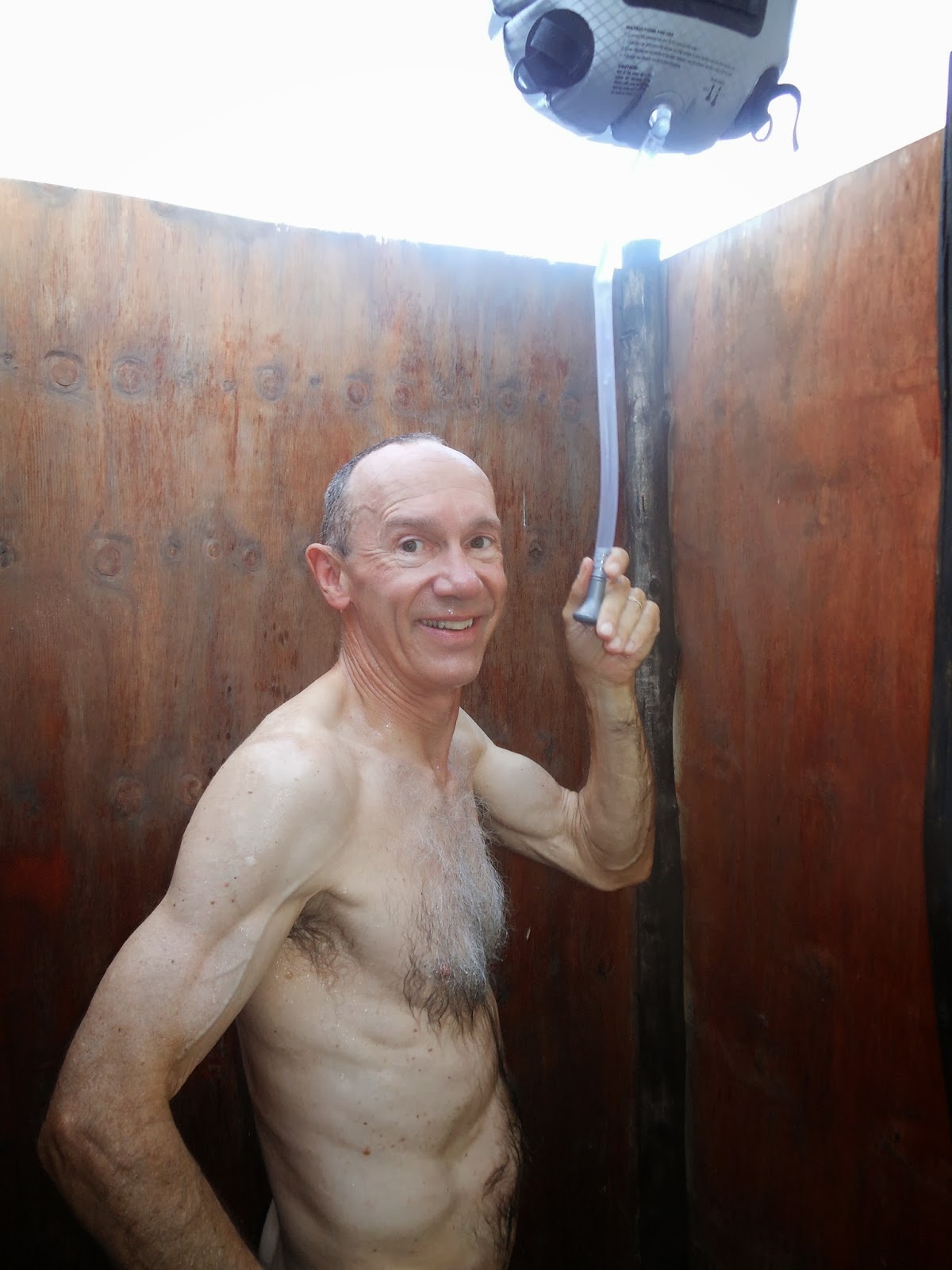
Our clever, thoughtful and loving children sent off a care package which arrived Friday and contained, in addition to speakers which can play my iPod (Offenbach and the Dixie Chix – more similarities than you might at first have thought), a solar shower, which we've hung in the nifty tiled curtained shower area the previous volunteers and one of the young men on the homestead had built. Continuing the X-rated trend in this blog, the shower is pictured, in use! This was, unfortunately, one of the rare cool and cloudy days, so my shower was brief.

We administered to two 5th and 6th grades and to an 8th and an 11th grade class (250 students, total) a 32 question Family Health International survey of the students' knowledge of how NIV is transmitted, whether they know people who are infected (they do, but may not know it – 31% of the adults in this country are HIV+!), how they feel towards people they learn are infected, and to whom they turn for information about HIV. The idea is to see what is needed and who the persuaders are. Then we returned to each of the 6 classes and told them what the survey showed, focusing on correcting erroneous understandings and trying to persuade them to be more accepting of those known to be infected, because apparently secrecy and shame are major obstacles to treatment. We ended up team-teaching most of these feed-back sessions, which generally went really well; we both felt more comfortable with the other to help out in a strange classroom, and I like to think we modeled a respectful male/female sharing relationship.

Here is Katherine explaining the survey results, with, behind her on the board, a list of the four substances that can transmit HIV; you try explaining to a class of 6th graders, boys and girls aged 11 to 16, what semen and vaginal fluid are. (Why is it that the teacher whose classroom we've taken over, and just as often the school principal, always seems to enter the classroom just as I'm about to try to explain to the students what semen is?) This is one of the less crowded classrooms; the 5th grade fits 3 of the little ones behind benches about that size. The girls all have extremely close-cropped hair, and sometimes shaved heads, so at this age I really can't tell the difference; it is helpful that the girls all wear skirts, even when on cold days they wear pants underneath the skirts.

Then we went outside to do an activity to make our points memorable. The PC used this approach of learning through activities this winter in training us, and I thought it worked well; I despair of achieving the needed behavioral change through lectures (see below). The class is in the courtyard, under the purple flowers of the jacaranda tree. To illustrate that people are easily fooled by appearances so you can't tell whether someone has HIV just by looking at them (so if you're not going to abstain, you better wear a condom; yup, we're telling that to 11 year olds – and none too early for some, from what I can tell), each line of students passes an apple behind their backs, and the other line facing them tries to guess who has the apple. When we did this in training, I watched KUF in the opposite line because I knew I could tell when she was trying to hide that the apple had been passed to her – she's the one who, many years ago playing Clue with friends, was randomly selected as the murderer, the only one allowed to lie, and she had to withdraw and we re-started the game because she is congenitally unable to lie, even in playing a parlor game with friends. I successfully identified the apple that way in training, but none of the kids in the 2 classes we did this activity with guessed right, which we think nicely made our point that you can't tell from appearances who is HIV+.

I received quite a few really helpful, thoughtful and remarkably learned responses to my plea for Biblical references for my school “ministry.” I chose the gospel of Mark (!) passage on Jesus and the leper, and then the “Suffer the little children to come unto me” passage from Matthew. I thought my presentation out pretty carefully, because I needed to try to hit an audience of boys and girls aged 6 to 14 with widely varied English comprehension, and I was treading a fine line on how free I felt to tell these kids exactly what God wants from them; the other teachers are very emphatic in telling the students what God wants, but I'm less sure of myself here. I gave my presentation to KUF the night before, and she was enthused, but the unexpected is always the most predictable outcome for me on this continent, and my “ministering” did not go especially well. It was a slightly windy day, blowing towards me, and I began with the students after they had been standing, praying and singing, for 15 minutes. (They line up, shorter to taller, under a corrugated metal roof, at 7:30 for assembly each morning.) I did not hold for very long the attention of the younger grades, whose English and attention spans were limited and, as the younger ones right in front of me started to whisper and fidget in their places, I started to lose some of the older, as well. They are used to a more declamatory, less explicating “Opening Statement” style than I have. I did not get much response from the other teachers, only about 1/2 of whom attended; the one comment was that a bi-lingual pun I tried to make with my name (Sipho Tsabedze = gift and blessing) was incomprehensible, and ended up sounding as if I was praying for myself. Oh, well. I've got lots of good additional material. I'll listen to the other teachers, and try to see what works. Thanks for your responses to my plea. Hope I'm asked to share again.

Friday, October 11, 2013

Lizards, and Spiders and Snakes, Oh My!


Lizards, and Spiders and Snakes, Oh My!

Oh yes, there are many creepy crawlies in Southern Africa! This is not safe Colorado any more. We share our hut with lizards, sort of like geckos but without the accent. Most of them are small and help control the bug population. There has been an occasional big yellow lizard which has gotten my attention, but mostly we know about their presence by the small droppings they leave behind, and sometimes by quiet skitterings we hear along the roof at night. I did see one big and very colorful lizard, maybe a monitor, during training, and hope not to encounter him again. The lizards for the most part are good neighbors.

The spiders come in all shapes and sizes. The big ones in our latrine (outhouse) can be pretty scary. Mark has been wonderful to rid the outhouse of spiders, but one recent spider even surprised him. Its body was bigger than a man's thumb and the rest of him (the spider) was the size of your palm. I didn't stay in the outhouse long! The centipedes are a good four inches long. To keep our huts bug free, we were advised by the Peace Corps to use “Doom”, a white powder which I have generously sprinkled around. We find lots of dead bugs and I can only wonder what effect the powder has on our bodies.

It is the equivalent of early April here – remember we are in the Southern Hemisphere so our seasons are just the opposite of yours - with hints of a long hot (very hot) summer ahead. Summer here is the rainy season and brings much anticipated moisture. Last year there was little rain and a poor maize crop. The result is many hungry people. With the rain also come the mosquitoes. Swaziland has almost eradicated malaria, but not quite, As a result we are on Mefliquine for 2 years and sleeping under mosquito nets. We spent some time this past weekend putting up netting on our windows. At night I feel a nice sense of security (maybe false) with my mosquito net all tucked in around me.

And now the snakes. First, I really don't like snakes and Swaziland has many snakes and they take them seriously. There are several types of vipers and the black mambas. I am told you can encounter them day and night. So far I have managed to not have any close encounters, but a small black mamba was killed just outside our hut recently. I was happy to miss his demise, but have had to alter my nocturnal habits as a result. Our latrine is some distance from our hut. I no longer visit the latrine at night. We have purchased a pee bucket! I know it is just a matter of time and the snakes would rather not see me, but rationality doesn't help.

Monday, October 7, 2013

Parents Day, and more adventures in African coifure


Since the 3rd term started Sept. 9, much attention has been devoted at my school to preparation for “Speech and Prize Giving Day,” (pretty much like Parent Day at Graland, although there were some differences) which occurred last Friday, October 4. More than 300 parents assembled in a large tent erected on the School grounds. The program was scheduled for 9 and got under way around 9:45. The Chief of the County and his entourage and also the Ministry of Education Guest Speaker and other national administrators arrived around 11. The students demonstrated their skills in reciting poetry (pre-school) and reciting in french (4th grade). Awards of 1st, 2nd and 3rd position were given for academic excellence, and also awards for cleanliness.

Towards the end of the program, around 2 PM, after speeches and entertainment by drum majorettes, choirs, a fashion show from the Home Economics class, and more, some of the older children did the traditional high-kicking dance, dressed in the skirt-like wrap that is their traditional wear (we posted a picture of Katherine attempting this dance from our July visit to the reconstructed “cultural village.”) At the school presentation, I am quite sure that some of these topless performers, including the one in the center of the picture, in the front row, closest to the camera, were 12 to 14 year-old girls. (For those of you feverishly searching our earlier blogs, Phumi was not topless in our earlier post. Anyway, not that day.) Girls wear long dresses, always below the knee, any time they are in any formal gathering, typically over a pair of tights or trousers, because apparently a woman's thighs are to be concealed, but these young women perform topless in front of their classmates and parents, and no one sees any incongruity. I guess its just what you are used to, or what you look for. Or something.
On an uncharacteristically cool and overcast Monday morning, with the never-ending wind, we walked up to a Neighborhood Care Point (“NCP”), one of 3 such locations within 3 kilometers of us, where volunteer moms cook and distribute food to between a dozen and 30 children 5 and under (over 5 would get at least one meal a day in school.), when food is available. They have these NCPs throughout the country, I believe. No child under 6 is turned away, I believe, but the target is Orphans and Vulnerable Children, especially those within “child-headed” homesteads. The food is distributed by the World Food Program, but WFP has told us they will terminate all food distribution here in December, 2013, because funding has run out. Since the US is typically a major funder of such programs, we suspect a change in US giving is threatening that devastating result here. The picture shows the unroofed enclosure where the Makes cook and serve the corn meal, enriched with powdered milk. The children bring the plastic buckets to the NCP, where the women help the children wash the buckets, which are about to be filled with corn meal, to be taken home and eaten. Usually they also serve beans, but beans take a long time to cook, and they did not get started in time.
Last Wednesday we went into Manzini, the nation's commercial center, with 2 missions: buying lighting; and getting Katherine's hair cut. Manzini has the only store we've been able to find that carries table and other lamps; Swazis don't read much at home, it seems, and go to bed early from all I can tell (but they stay up to watch Generations, a South African soap opera along the lines of Dynasty, I think – but more repetitive, and angry, and not as well acted, if you can imagine that), so apparently they have no need for lamps. We did, and bought the place out.

But no such luck on finding someone willing to cut a white person's hair. That's not racist – our hair is demonstrably different. (An 18th century Swazi king had a dream telling him to welcome the pale people with hair like cows' tails who would come with a book and coins; the dream told him they should take the book – the Bible, which they certainly did – and reject the coins; they are re-thinking the latter part of the dream.) No one in town would take on cutting Katherine's hair, except for one salon that wanted $US 18, which we certainly weren't going to pay – we're volunteers! So on Saturday we walked up to the salon at our little cross-roads, and they called in the specialist, who did a number on us: $3 for a cut and shampoo for KUF and worth every penny of it, don't you think? And $1.50 (US) for me – I think you'll agree I got my money's worth – about 1/8th of an inch left, in every direction. Next time I think I'll try to sweet-talk Phumi into doing mine with the electric scissors we bought; more . . . stylin', don't you think? What do you think my chances are?

The picture shows our bedroom behind us, with the mosquito netting over the beds (really not very necessary yet, and we have the departed PCV groups used mosquito netting velcroed to the windows as screens, but even one of the little fellows is annoying; we don't have much fear of malaria – its not very prevalent here, and we take Meflaquin every Saturday morning), the bedside table we made from the box the electric oven came in, and our precious lamps. (Actually the lamps don't work that well – we're each asleep within about 2 minutes of getting in bed, often with the light still on.)

Some have expressed concern about the effect on us of the shutdown of your government, but, remember, we are volunteers, we get only a living allowance, so cutting off funding wouldn't pay to polish Ted Cruz's or John Boehner's shoes. But going on furlough – that would have been nice! We were advised Monday afternoon by text message (the means of communication when they want us to know something, because text messages, to phones, get through, whereas emails are a sometime proposition) that furloughs would not be “required” of overseas personnel, and that we should keep up the good work. Oh, well. Thanks all the same. Hope they get it figured out before someone notices. We can tell from emails from family and friends, and some NY Times headlines, its making a difference back home. Sorry.